The powerful God who reigns in weakness

What does it look like when Jesus unites humanity under his leadership as the kingdom of God? For the church today, that might be the most important question, because that’s our identity, and it defines our mission.

Firstly, this is a radically different kind of politics. We’re accustomed to the world of party politics. The Liberal Party seeks power from and for the business owners. The Labor Party seeks power for the workers. The Nationals seek power for the landowners, and so on. Within each party are factions (left, centre, right), each seeking to gain more control of the party, in the hope of their party controlling the country.

Then there’s the division of countries, with different political systems: democracy, socialism, monarchy, republic, and so on. On the world stage, countries fight for self-interest. Looking back, history looks like struggle of the species, a political “survival of the fittest.” The strongest beasts survive to rule the world, and the winners write history (compare Daniel 7).

The Bible describes an alternative story of politics. Earth’s true sovereign — the king we sideline when we grasp for power, fight wars, and subjugate each other — takes the side of the suffering, not those who cause their pain:

Continue reading “The powerful God who reigns in weakness”

Saviour of the world

“This man really is the Saviour of the world.” (John 4:42)

An International Red Cross survey found “millennials are nervous about their future and see cataclysmic war as a real likelihood in their lifetime.” Add catastrophic fires and climate disaster, and it’s not hard to see why many people live in fear.

Does the gospel address our global fears? Or is it about how to escape from a world that’s likely to blow up? Is Jesus merely a personal Saviour? Or is he the Saviour of the world? Continue reading “Saviour of the world”

Jesus as Saviour

What do we mean when we call Jesus “Saviour”?

Would you describe Jesus as your personal Saviour? That’s good, but that’s only a tiny fraction of what the Bible means when it calls Jesus Saviour.

Let’s try a story. What’s your favourite spy movie? You know those ones where our agents have been incarcerated in a foreign land and condemned to death. With meticulous planning, satellite intelligence, and drone support, we send in the commandos to bring them home. Commandos are the “saviours” in our culture.

The gospel is that kind of story, with more intrigue and less gunfire.

Continue reading “Jesus as Saviour”

Relationship with God

So, how’s your relationship with God? Personal? Troubled? In love? Inert?

The question is helpful for some, but I’ve noticed others retreat. They feel like God isn’t speaking to them. Or their life is a struggle right now. If they felt safe enough to give an honest answer, they might respond like Job, “If only I knew where to find him” (Job 23:3). Continue reading “Relationship with God”

Society on the couch

Can you use cartoons in an academic paper? Ann Fink did. Her article is a case study I may use in ethics class.

She asks how to treat this police officer. During Algeria’s War of Independence, he presents to Dr Frantz Fanon (psychiatrist) suffering PTSD (posttraumatic stress disorder) as a result of his work, which involves torture. He’s not coping, and his home life is becoming increasingly violent.

The patient asks Fanon “to help him torture … with a total peace of mind.” Is it possible to treat the inspector in a meaningful way?

How would you advise the doctor?

Continue reading “Society on the couch”

Why have you forsaken me?

If you’ve known rejection, you’ll appreciate this.

If you’ve felt abandoned, discarded by family and friends, you may understand this:

Mark 15 34 At three in the afternoon Jesus cried out in a loud voice, Eloi, Eloi, lema sabachdthani?” (which means “My God, my God, why have you forsaken me?”)

What was Jesus saying? Continue reading “Why have you forsaken me?”

Are the Psalms messianic?

Do the Psalms tell us about Jesus? Are these verses about Christ?

Psalm 22 1 My God, my God, why have you forsaken me? … 16 They have pierced my hands and feet.

Psalms 118 22 The stone the builders rejected has become the cornerstone.

The New Testament writers thought so. So did the church fathers. Were they right? Or were they bending texts to fit their beliefs? What did David intend? Does authorial intent define the meaning? Or is meaning in the ear of the hearer, whatever the reader wants it to mean?

When the church fathers used the Psalms this way, the Jewish leaders were mortified. They pointed out that no one read the Psalms like this until after Jesus died, so the Christians were merely imposing their own meaning on Jewish literature.

Should we be seeing the Messiah in the Psalms? Everywhere? Nowhere? In a few cases? What do you think?

Continue reading “Are the Psalms messianic?”

How to read Psalms

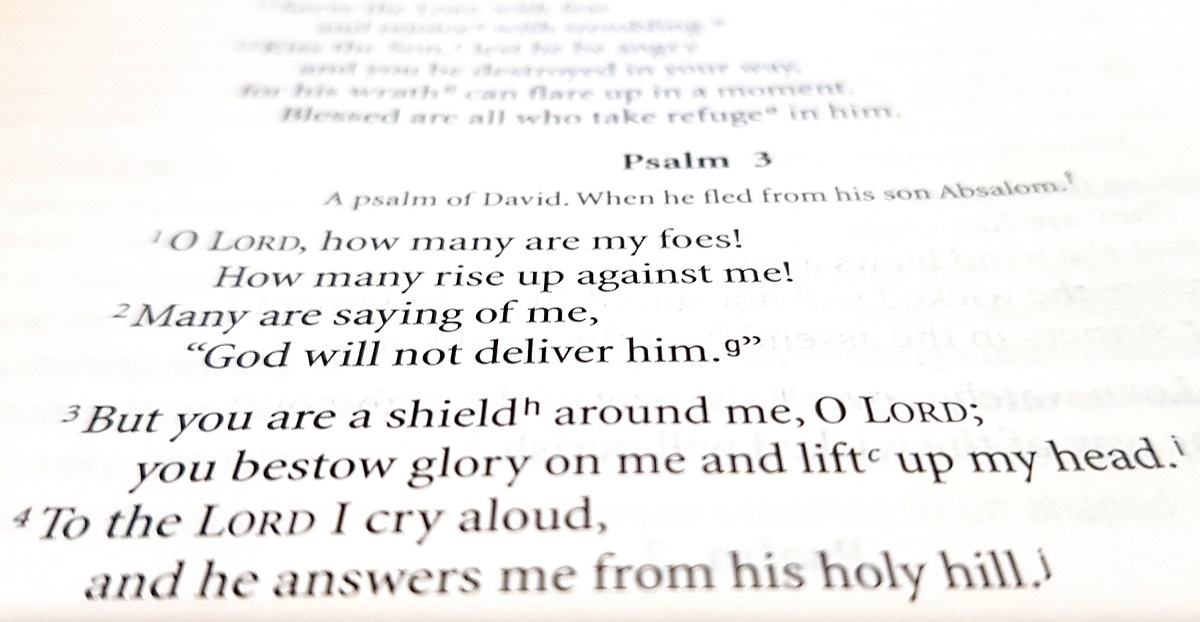
This post is longer than normal. It walks you through how to process the Psalms, with Psalm 3 as the example.

Open Psalm 3.

How do you read Psalms? We love the first one: a fruitful tree by the stream. Psalm 2 is more confronting, but we like to read about God’s anointed Son. Then Psalm 3 is about facing enemies. What do you do with that?

If you don’t have enemies, perhaps you skip it and try to find something more joyful? Or perhaps there is someone who’s making your life difficult, so you read on … until you reach verse 7. Are you really supposed to pray, “God smack them in the face and smash their teeth in?”

If you ever end up in court for punching someone, please don’t offer as your defence, “The Bible told me to.”

There is a better way to read the Psalms. They aren’t about “me and God.” You won’t get far if you approach them with the attitude, “What’s in it for me?” You need to ask, “What has this meant for God’s people before me?”

Whose voice?

Who is the me in Psalm 3? No, it’s not you, the twenty-first century reader. Who poured out this graphic lament about the enemies arrayed against him? Any ideas?

Continue reading “How to read Psalms”

Time to rest

Taking it easy now Christmas is over? Catching up on some rest? Or is Boxing Day “shop ’til you drop?”

What is rest for you? Laughing with family after a meal? Time to yourself? Watching a movie? Savouring a good book? Playing golf? Walking on the beach? Falling asleep?

I’m not suggesting we observe the Sabbath. Legislated rest seems a bit like “Hurry up and relax!” The Ten Commandments were laws God gave Israel. Nowhere were the nations commanded to take Sabbath rest. But are we missing out? Continue reading “Time to rest”

Should Christians support or oppose Trump’s impeachment?

What should Christians make of Donald Trump’s impeachment?

  • Is Christianity Today right to condemn him as unfit for office, that he “should be removed … not a matter of partisan loyalties but loyalty to the Creator of the Ten Commandments”?
  • Is Franklin Graham right to keep supporting him, claiming “No President has done more for the Evangelical community”?

Do Christians have a moral responsibility to stand up for righteousness? Or should Christians stay out of politics? What’s our role?

Continue reading “Should Christians support or oppose Trump’s impeachment?”

500 posts

This is our 500th post. It’s a gift to you: an online resource to help you see life the way Jesus saw it — as the kingdom of God.

With the Scripture Index, you have a free commentary on Matthew 1-14 (144 posts). We’ve also covered Genesis 1-36 (71 posts) and Exodus 1-14 (35 posts), showing how to read the Old Testament as the kingdom story. We’re currently in Ephesians (20 posts), since the epistles spell out how to live as the kingdom of Christ Jesus our Lord.

Continue reading “500 posts”

How credible is faith now?

Who do Aussies trust? The ABC asked us, and our answers are revealing:

  • We trust:  doctors/nurses (97%), scientists (93%), police (84%), judges (80%).
  • We mistrust:  celebrities (8%), politicians (19%), corporate executives (20%), religious leaders (29%).

Celebrities are fake, of course. Actors are somebody they’re not. When Jesus spoke of hypocrites, his word literally meant an actor, someone playing a role in a Greek play. He called the religious leaders actors. Aussies agree.

But if the church’s message is faith (trust), while our leaders are not credible (not to be trusted), will the church disintegrate? Will people vote with their feet? Continue reading “How credible is faith now?”

Mary’s Christmas message

Mary was overwhelmed. A torrent of thoughts and emotions. A flood of fears and hopes. Her life would never be the same. What would this mean?

She was giving birth to someone greater than Caesar. She was trusted to raise the child who would conquer the world. Nobody’s life would ever be the same.

She was still processing it months later when she left Nazareth to stay with Auntie Elizabeth. She was still processing it years later when her son grew up and left home. Her roller-coaster of emotions finally took shape — in the life of her son.

Years later, she had another visit: not an angel, but a researcher interviewing eye-witnesses for a biography. Her friends assured her she could trust Doctor Luke. So, she did. Her deepest thoughts and feelings made it into his book:

Continue reading “Mary’s Christmas message”

Alternative views of our role in his kingdom

In this post, we consider some other views of what kingdom work could be.

In our last post, we defined kingdom work as “implementing communal life under the king.” In this post, we’ll consider other views on what kingdom work could be.

Since we have limited time and resources, the king’s tasks are our priority. We don’t want to be tangled in tasks that are tangents.

So, let’s evaluate some common proposals. (Skip to Proposal 5 if you wish.)

Continue reading “Alternative views of our role in his kingdom”

What is our role in his kingdom?

What constitutes kingdom work?

Kingdom work is a catchphrase for everything from social justice to church fund raising. But does it mean to work for the kingdom?

At the simplest level, kingdom work is doing what the king wants done.

We just need to be clear about what the king wants us to do. Is it individual piety, or getting people saved? Is it doing church work, or exposing injustice in society? Or is there no such thing as kingdom work, because the kingdom comes from God’s work, not ours? You’ll find people advocating all those positions.

How do we find out what the king wants done? The New Testament could provide some insight: Continue reading “What is our role in his kingdom?”

How does the kingdom come?

There’s one person who liberates us from oppression, into God’s reign.

Everyone in Jesus’ world knew what the kingdom of God was. It was the story they were living in. It started with Eden. Its restoration was promised to Abraham. It became a thing under Moses. Earthly kings like David represented God’s kingship. But it fell apart when Assyria and Babylon destroyed Israel as a nation.

So how would it be restored? They all knew what it was, but there were differing views on of how the kingdom of God would be restored. Continue reading “How does the kingdom come?”

What is the gospel of the kingdom?

When you hear the word “gospel”, do you think of God’s kingship being restored on the earth? Jesus did.

Jesus’ gospel was different to ours. Here’s how the Gospels summarize his message and mission:

Matthew 9 35 Jesus went through all the towns and villages, teaching in their synagogues, proclaiming the good news of the kingdom and healing every disease and sickness.
Luke 4 43 He said, “I must proclaim the good news of the kingdom of God to the other towns also, because that is why I was sent.”

What is the gospel of the kingdom? How is it different to a gospel of personal forgiveness? Jesus’ gospel is on a different scale — the difference between liberating a prisoner and liberating a planet. Continue reading “What is the gospel of the kingdom?”

Who is the king?

All our fuzziness about the kingdom becomes clear when we ask, “Who is the king?”

Here’s a single question to clarify Jesus’ teaching on the kingdom: Who is the king?

That question has two answers:

  1. God is king. It’s the kingdom of God.
  2. Christ is king. God entrusted his kingship on earth to his anointed (Christ).

Our heavenly sovereign doesn’t impose his rule on us; he exercises his reign through us. He designed us to be images of his dominion, for the benefit of all the creatures on earth (Genesis 1:26-28; Psalm 8).

That’s why God promised to restore his reign through humans, through Abraham’s family. When Israel asked for a king, God agreed to have a son of David representing his reign on earth (2 Samuel 7:11-16). God’s reign is through “the Lord and his anointed” (Psalm 2:2).

So Jesus is God’s Anointed (the Christ). But Jesus rarely promoted himself. If we don’t realize that he’s talking about his own kingship, his kingdom teaching can sound cryptic.

Continue reading “Who is the king?”