Tyrants or tempests? From what does Jesus save? (Matthew 14:22-33)

“Jesus saves” from what? Tyrants (systemic injustice)? Tempests (natural disasters)? Transgressions (personal guilt)?

Open Matthew 14:22-33

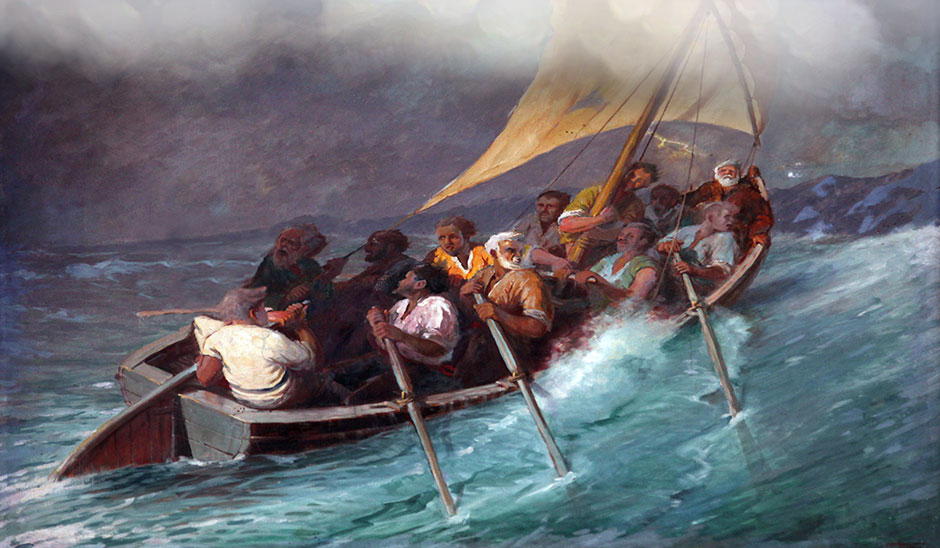
Some disasters are manmade. We hurt each other in our families, businesses, and communities. We’re harmed by war, racism, the injustices of power. We also face disasters beyond human control: cyclones, earthquakes, pandemics. Which kind does Jesus save us from?

Matthew 14 answers that question.

Continue reading “Tyrants or tempests? From what does Jesus save? (Matthew 14:22-33)”

Reading together

Before the printing press, few people had a Bible of their own. It was a shared book. People read together. The Old Testament was the Jewish community’s story. New Testament letters were for churches. The Gospels were communal memories, reflected in the way the Synoptics use identical phrases to tell Jesus’ story.

Then the printing press gave us each a Bible of our own. Reading it as a private book, we fragmented into 40,000+ denominations. There are people in our culture who promote the notion that a text can mean whatever a reader wants (reader-response theory).

Today we tend to read the Bible alone. I bring the Bible into my private world, searching for spiritual guidance for my life. I identify each character with my struggles, glossing over the bigger story of the faithful Father who reigns across the families and generations. Almost imperceptibly, I am the centre of my universe.

Continue reading “Reading together”

Is God angry with us?

God feels anger, because God is love.

It was the perfect site for a wedding: a quaint old church, perhaps the oldest in our state. Two nights before, the couple arrived for a practice. The chapel was open but unattended, so they went in and began arranging things. They didn’t know what the baptismal font was, so they were just moving it out of the way when the aged priest stormed in. To this day I can still hear the angry crescendo of his livid voice.

A priest is a representative of God. This priest was the image of an angry God waiting in the wings for you to do something wrong so he could pounce. Is God like that?

The Bible does speak of God’s anger. This week a small group leader asked about Ephesians 2:3b: Like the rest, we were by nature deserving of wrath. Is God angry with us?

Continue reading “Is God angry with us?”

Daniel: Who’s running the world? (podcast)

It could have been today’s news: Daniel describes superpowers mistreating people of Jewish ethnicity. But he saw a higher power running the world.

What is the message of the Book of Daniel? It’s not disconnected stories of lion’s dens and fiery furnaces. It’s not a mysterious code for dating the end of the world.

Daniel wrestles with, “Who runs the world?” This was no theoretical question, given that Babylon had taken over Jerusalem. Could the kingdoms of this world implement God’s rule? Or would the restoration of God’s reign require divine intervention? And how do God’s people cope in dark times?

This podcast (32 minutes) surveys the message of Daniel — the restoration of God’s kingship in a world gone wrong.


Joining Jesus’ fight against evil

How do we respond to the George Floyd’s suffering? Here’s a message from a martyr.

It’s 2020, and a black man’s life is cut short by a policeman’s knee. I understand the outrage. What I don’t understand is why this is unexpected. Continue reading “Joining Jesus’ fight against evil”

How to approach the Book of Revelation (podcast)

Where do you even start with a book like this? Look for Jesus: it’s all about him.

Revelation is the most puzzling and tantalizing book of the Bible. What’s it about?

This 30-minute podcast explains how John’s visions are about Jesus. The whole sweep of the Bible’s narrative comes together in this final episode, in the person who is good news for the world.


Previous podcast series on Genesis:

How to glorify God?

If God is great, what are we?

We know the chief aim of humanity is to glorify God. But how?

  1. Do we reflect God’s character in his world, so people see God in us?  OR
  2. Do we tell people to look at God and not at us, since we fall so far short of the glory of God?

Does our connection with God make us great too — God’s handiwork, the image of his character? Or would that approach make us prideful sinners who seek God’s glory for ourselves?

Continue reading “How to glorify God?”

Joseph: servant of the king (podcast) (Genesis 37–50)

How did the patriarch Joseph contribute to the story of the kingdom of God? This podcast (20 minutes) shows us how to hear the story of Joseph as the story of God.

We’ve now surveyed Genesis in four podcasts. The previous three:

The Scripture Index contains 75 articles on Genesis if you’d like more detail.


Image: Egyptian throne, Tutankhamun exhibition.

Why did Paul never speak of Jacob?

If Jewish people find their identity in Jacob, why do Christians focus on Abraham?

Conversations make you think, especially conversations with people who see things differently to you.

Last year, I was chatting with a Rabbi about Abraham, Isaac, and Jacob. She knew Christians emphasize Abraham, but for Jewish people the emphasis falls on the third person of the patriarchal triad. Jewish identity is children of Israel — literally, descendants of Jacob. The man Jacob was Israel in the first generation.

That’s why the name Jacob regularly referred to the nation of Israel in later generations, especially in poetic passages. The nation is not Abraham, but it is Jacob. Examples:
Psalm 53 … let Jacob rejoice and Israel be glad!
Isaiah 43 1 … he who created you, Jacob, he who formed you, Israel …

In the Psalms and latter prophets (Psalms – Malachi), Abraham’s name appears only 11 times, while Jacob’s name appears 127 times. The nation’s identity was primarily in Jacob, not Abraham.

So, why are Christians more focused on Abraham? Continue reading “Why did Paul never speak of Jacob?”

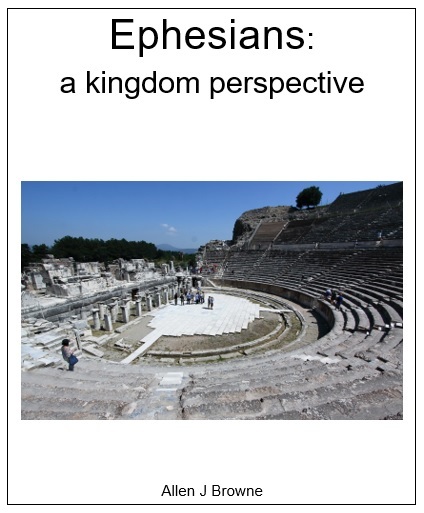
Ephesians: a kingdom perspective (free commentary)

Here it is. Our first commentary on a book of the Bible, from the perspective of the kingdom of God.

We covered Ephesians over six months. Those 50+ posts have now been compiled into a free, downloadable commentary.

As the reverse of the title page explains, you have permission to use it yourself, share it with others, use it academically — basically anything except selling it for profit.

Here’s the PDF (1 MB). This is the best format for general use. Enjoy.

Update 2022-04-18: commentary updated (typos fixed, quotations included).


For Logos users

If you use Logos Bible Software and would like to compile this as a Personal Book, here’s the DOCX (600 kb) and cover (62 kb). Continue reading “Ephesians: a kingdom perspective (free commentary)”

Solving the world’s problems

What God is doing is effective: it will transform the world.

You might think it’s always off, but Eurovision really is off this year (2020).

That didn’t stop a Dutch team using a computer to generate a new Eurovision song. They fed it input from previous Eurovision hits and from social commentary site Reddit. Reportedly, it wrote a song “that crescendos as a robotic voice urges listeners to ‘kill the government, kill the system.’”

Artificial Intelligence (AI) doesn’t create those ideas. It reflects what people say. There must be quite a few anarchists reacting to the oppression and systemic injustice in the world for AI to produce that song.

Unfortunately, many of us in church don’t think of sin like that. I think of sin as my faults, the ones for which I need forgiveness, because that’s how I get saved. We lose the world-transforming power of the gospel when we reduce it to a story about me and how I can get my forgiveness. Sin isn’t just a problem in each individual. It’s the oppressive power that dominates the world, causing all the wars, all the social devastation, all the problems the anarchists react to.

Jesus acknowledged the oppressive power of sin, but offered a very different solution. The problem with “kill the government, kill the system” is that it adds fuel to the fire, feeding the cycle of violence. Jesus’ radical idea was to replace the cycle of violence (the power of sin) with God’s reign.

Jesus took no sword to Caesar. He took the cross from Caesar. Continue reading “Solving the world’s problems”

Jacob and the kingdom of God (podcast) (Genesis 25–36)

This podcast (27 minutes) discusses the significance of Jacob for the kingdom of God.

Jacob was Israel in the first generation. His life story is told in Genesis 25–36 in a way that his descendants could relate to, for the promises he received were being fulfilled through them.


Previous podcasts

Peace and grace: the greeting that can deliver (Ephesians 6:23-24)

More than a wish; this good news heals the world.

Ephesians closes with two brief blessings that pull together the main themes of the letter. Peace and grace were common greetings in both the Jewish and Asian communities, but these words are much more than well-wishes. The good news in this letter is the divine grace that brings peace to the world. Continue reading “Peace and grace: the greeting that can deliver (Ephesians 6:23-24)”

A courier for God’s house (Ephesians 6:21-22)

With no Fed Ex or postal service in the first century, letters like the one we’ve been reading (Ephesians) were carried by hand. That’s why we’re introduced to Tychicus, the courier tasked with personally delivering this letter. Continue reading “A courier for God’s house (Ephesians 6:21-22)”

Staying in touch with our king (Ephesians 6:18-20)

Got each other’s back?

Communication matters. Did you see Sam Mendes’ movie, 1917? Two soldiers were tasked with carrying a message across enemy lines, a message that could save the lives of many compatriots. Technology has come a long way in the last 100 years, but the movie reminds us how crucial communication is for saving lives. Continue reading “Staying in touch with our king (Ephesians 6:18-20)”

Abraham and the obstacles to God’s kingdom (podcast) (Genesis 12–25)

Abraham lived his entire life for the kingdom of God.

This podcast (28 minutes) surveys Genesis 12–25 as the foundational story of the kingdom of God.

God founded his human rescue project in Abraham and Sarah. They left the region of the Babel-builders to establish a nation under God — a representative kingdom of God among the nations. The obstacles they faced are the obstacles that threaten God’s kingdom project. They trusted God, even though restoring God’s kingdom would take many lifetimes.

When I first blogged these thoughts four years ago, it became my most popular post (downloaded more than 10,000 times). Enjoy this podcast version.


Previous podcast: The world is God’s kingdom (Gen. 1–11)

On grace: John Barclay, “Paul and the Gift” (book review)

“A gift can be unconditioned (free of prior conditions regarding the recipient) without also being unconditional (free of expectations that the recipient will offer some ‘return’).”

The word “grace” encapsulates so much of the gospel, so I was blown away by John Barclay’s masterful study of this word: Paul and the Gift, published by Eerdmans in 2015. It’s big (672 pages), pricey (US $55), and academic, though at the time of this review it was available on Kindle for US $4.50.

If you just want a concise summary, choose Barclay’s Paul and the Power of Grace (Eerdmans, 2020, 200 pages). For me, the larger book was worth the effort. It’s a superb example of how to pursue a word study: I learned as much from his method as his content. Continue reading “On grace: John Barclay, “Paul and the Gift” (book review)”