
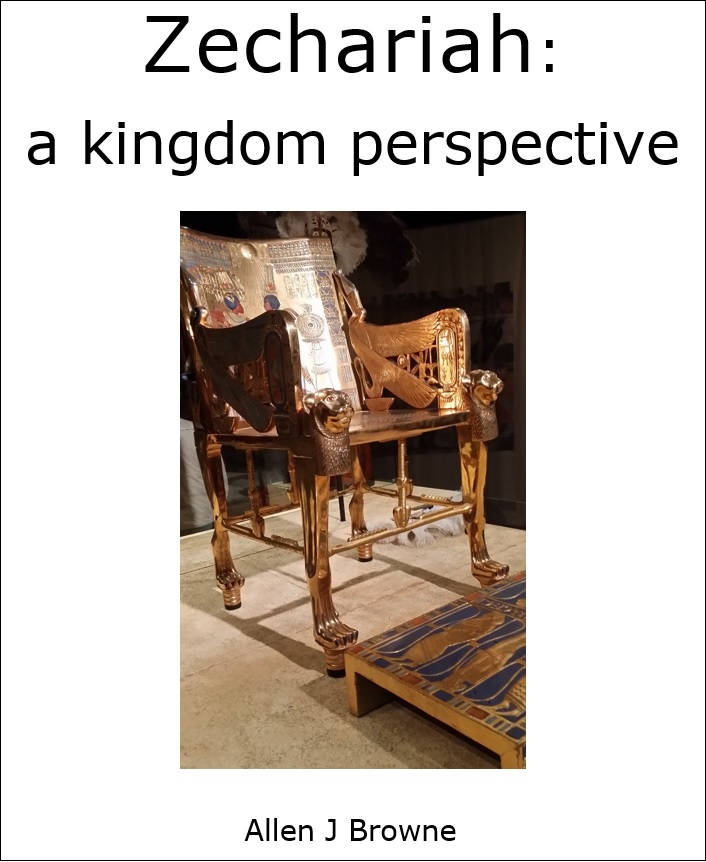
Here is a free commentary on Zechariah for you to download (PDF, 1MB). It contains all our 2021 posts on Zechariah, including the introduction (below). Enjoy.
Continue reading “Zechariah: a kingdom perspective (free commentary)”
Free commentary containing the 2021 blog posts on the Book of Zechariah.
Here is a free commentary on Zechariah for you to download (PDF, 1MB). It contains all our 2021 posts on Zechariah, including the introduction (below). Enjoy.
Continue reading “Zechariah: a kingdom perspective (free commentary)”
Podcast and mediation on John 10:1-18.
“I am the good shepherd,” Jesus said.
Did he dream up this image? Or was it a widely used metaphor?
Why good shepherd? Were there bad shepherds?
Who were the thieves and robbers, trying to climb in some other way?
What makes Jesus the gate of the sheep?
This podcast (36 minutes, from Riverview Joondalup, 10 October 2021) will transport you from the children’s picture-book image of a little lamb in Jesus’ arms to a more expansive image: humanity’s true shepherd, the gate of the sheep.
The Lord will be king over the whole earth (Zechariah 14:9)
A restructure is common when a new leader takes office. Zechariah’s final chapter envisions a restructure of creation as it comes under divine sovereignty. The heart of the chapter is this: The Lord will be king over the whole earth (14:9). And changing the king changes the kingdom.
In an alien world, Star Trek’s Spock would say, “It’s life, Jim, but not as we know it.” Zechariah is not seeing an alien planet; he’s seeing the removal of everything alien to God’s intentions for life on earth, the terraforming of our planet.
With impressionistic brushstrokes, Zechariah paints an image of God’s reign transforming everything:
Continue reading “Zechariah’s vision of God’s reign (Zechariah 14:4-21)”
(Warning: explicit language)
She’s one of the most creative singer/songwriters of our time. Her mystic is the strangeness that never belongs to any genre, a feeling that things are never quite as they seem.
She’s chilled, with lyrics that can be chilling.
She’s a warm soprano, with the highs filtered out.
She’s the mellow whisper that draws us into her trance.
Complementing her voice are filtered electronic rhythms, smooth bass, edgy guitars and percussion, blended by the master-chef Finneas — the less conspicuous member of the duo. She may be a soloist, but it can take a symphony orchestra to create that sound.
That’s all part of the enigma that attracts us to her music. When things don’t quite match, we’re drawn to explore further.
Continue reading “Happier than ever: what I heard from Billie Eilish”
Why did Jesus portray the Holy Spirit as his advocate from the Father?
In a previous podcast on John 14, we heard Jesus introducing us to the person of the Holy Spirit. In this podcast on John 15–16, Jesus introduces us to what the Holy Spirit does. Together, John 14–16 provide a theology of the Spirit (pneumatology): the person and work of the Holy Spirit, according to the founder of our faith.
So, what does the Holy Spirit do? What is his mission as the Advocate, the Spirit of truth? This 27-minute podcast was recorded at Riverview Joondalup, 26 September 2021:
My translation (compare NIV) highlights the courtroom metaphor that permeates these chapters, as Jesus was about to be put on trial by the powers that claim to run the world:
Continue reading “Holy Spirit as Advocate (podcast) (John 16)”
If God isn’t visible to our physical senses, so how do we see him?
Where do you look to find God?
This podcast (34 minutes) suggests the answer is relational — in the relationships that exist between Jesus, the Father, the Holy Spirit, the people who recognize Jesus’ authority, and the world that doesn’t.
Spoken at Riverview Joondalup, 19 September 2021, it draws from this text:
Continue reading “How do you find God? (podcast) (John 14:8-17)”
The king’s authority sets the servants’ task.
The great commission begins with all authority. Without understanding who is king and how he uses his authority, we’re likely to misuse that authority.
We’ve heard that it was said:
Go into all the world and convert everyone to Christianity.
What he said was more like this:
All authority in heaven and on earth has been entrusted to me. On that basis, everywhere you go you are to train the nations, plunging them into the leadership given by heaven for the earth: the authority of the Father, his Son, and the Holy Spirit.
Your role is training the nations to obey what their king has commanded. And I promise you I will always be with you my servants, until the goal of the era is fully accomplished (i.e. heaven’s authority is fully restored to earth).
— paraphrase of Matthew 28:18-20.
Begin with his authority, and his commission takes meaningful shape.
Continue reading “Great authority for a great commission (Matthew 28:18-20)”
Being aware of how we use language helps us understand each other. And Scripture.
No, that’s not today’s headline. But it will be familiar if you follow AFL (Australian football).
On 15 August 2021, Fremantle Dockers defeated West Coast Eagles (70-64). It was the first time Freo won in 12 derbies (clashes of the local teams). In one of the 2019 derbies, the Eagles almost quadruples the Dockers’ score after Fremantle went on a spree of kicking behinds: 2.19 (31) to 19.8 (122).
This language is so familiar to us that we don’t even consider that “kicking behinds” could have other meanings. But imagine a researcher in 2000 years trying to make sense of our history. Our news headlines have been preserved in a database, but they know nothing of AFL.
So, they read the headline, and consult their English lexicon for the meaning of the words. It tells them that an “eagle” is a large predatory bird, and a “docker” is someone who works on the docks loading and unloading ships. They wonder if “Derby” is a port. And there it is on their maps — on the northwest coast of Australia. Can you imagine the picture forming in their minds of what the headline means?
This is exactly the kind of problem we face when reading the Bible. The Bible is not some kind of encyclopaedic wiki on spiritual truth. It’s a record of God interacting with humans in various times and places, so it’s a revelation of God: his faithful character and unswerving purposes for us. But since it’s rooted in particular people struggling in particular settings, we cannot understand what it means if we misunderstand what it meant for them.
What does it mean to be a Christian?
Writing to Rome, Paul spent eleven chapters explaining who Christ is in relation to us, and then five explaining who we are in relation to each other under Christ’s leadership. Short answer: Christians are the community in Christ. Our identity derives from the leader God appointed for us.
This podcast draws on the transitional chapter of Romans, in fresh translation. Recorded at Riverview Church’s Joondalup campus, 15 August 2021 (34 minutes).
Open Mark 8:27-35 (ESV).
What do we mean when we say Jesus is the Christ? Is it merely part of his name? Or did Peter have something more in mind when he declared Jesus to be the Christ?
This is no minor matter. It goes to the heart of the Christian faith. It needs to be discussed in our churches, since Jesus’ identity and mission defines our identity and mission. So, how do we teach on this for a Sunday congregation?
This podcast (24-minutes) is from the message delivered to Riverview Church’s Joondalup campus on 8 August 2021.
Continue reading “You are the Christ (podcast) (Mark 8:27-35)”
Puzzled over how to understand God’s sovereignty? It’s the hope of a suffering world.
Zechariah’s final chapter extends astounding hope in a puzzling framework.
Continue reading “Divine sovereignty and human suffering (Zechariah 14:1-5)”
Why was the shepherd of God’s people struck? Why did Jesus relate Zechariah’s message to himself and the scattering of his little flock?
Open Zechariah 13:7-9 and Matthew 26:31-32.
The night he was arrested, Jesus expected his friends to abandon him. He knew they would because the prophets said so.
Matthew 26:31 Jesus told them, “This very night you will all fall away on account of me, for it is written: ‘I will strike the shepherd, and the sheep of the flock will be scattered.’” (NIV)
Reading Zechariah 13, it’s not immediately obvious why Jesus would apply this to himself. To make sense of how Jesus understood the text, we need to read the prophets in the context of the story they were telling.
Interested in seeing the gospel in the Old Testament? This example from Zechariah 13 shows how to (and how not to).
Open Zechariah 13:1-6.
The ideal kingdom is a wise king with a responsive community. Zechariah’s hope is for Israel’s failed kingdom to be restored after being exiled and dominated by foreign powers. He anticipates what life could be like on that day (13:1, 2, 4).
King and kingdom are reconciled as God gives them a spirit of grace and supplication, and they respond by seeing how they hurt him — looking on the one they have pierced (12:10). They stabbed God’s heart by rejecting his kingship, giving themselves to other rulers and their gods. This has been Zechariah’s core message: Return to me, and I will return to you (1:3).
So, on that day when they turn back to God’s kingship, God cleanses the house of David — the kingship God sacked because they were self-serving. On that day, God cleanses the inhabitants of Jerusalem — the people who gave themselves to other rulers and their gods.
Based on the Torah, Israel was to be a nation under God’s leadership. Their sovereign gave them his laws and defined how to remain ritually pure in his presence. Sin or impurity could make them unclean, so he provided cleansing rituals (e.g. wash occurs 35 times in Leviticus). So when they turn back to God, Zechariah declares that God will open a fountain to cleanse his people, so they’re devoted to him alone:
Continue reading “A cleansed, non-prophet kingdom? (Zechariah 13:1-6)”
Finally got vaccinated. Want to know why?
Okay, I’ve had my first CO-VID vaccine shot. Reactions from friends ranged from:
I was slow off the mark because here in Western Australia we’re so socially isolated already that it made sense to let others go first (medical staff, quarantine workers, aged care staff, people in the eastern states).
To answer the second question, let me tell you a story.
“They will look on me, the one they have pierced.” What does this mean in its OT context? How does it relate to the Messiah?
Open Zechariah 12:10-14.
How do you understand this astounding statement from the Old Testament?
They will look on me, the one they have pierced, and they will mourn for him as one mourns for an only child, and grieve bitterly for him as one grieves for a firstborn son (Zechariah 12:10).
There’s a strong temptation to simply read this through the lens of the cross: Jesus the Father’s only Son, God pierced for us. That may be how the story plays out (compare John 19:37), but we miss the richness if we don’t ask what it meant in Zechariah’s context.
When Zechariah says, “They will look on me”
How could they pierce me?
And how can God’s people piercing him be compared to grieving for a firstborn son?
Zechariah is unfolding a very specific story: the story of God’s anointed (the Davidic king) representing heaven’s authority (the kingdom of God) in a world where people (both the inhabitants of Jerusalem and the nations) resist God’s reign.
Continue reading “The one they pierced (Zechariah 12:10-14)”
What does it look like to live the gospel? Romans 12:9-21 translated into life.
I’ve been meditating on Romans 12 as the-gospel-in-practice.
Romans 1–11 explains what the good news is. Romans 12–16 explains what it means to inhabit the world transformed by the gospel under the Messiah as Lord.
Here’s a fresh translation of Romans 12:9-21 from that perspective. The verbs are plural (love, detest, collaborate, etc), so the message is not so much about individual piety as it is about participating in the restoration of the world as the kingdom of God in Christ (the goal of the gospel).
Our sufferings at the hands of evil are transformative for the world, as we participate in the redemption that’s taking place in Christ.
That defines our approach to justice and our response to injustice.
So, see what you think. Any suggestions for a better translation? Any important nuances I’m missing? Any further inspiration you find in this passage? (Comment below.)
What God promised for his people is often frustrated by our unfaithfulness. The good news is that all the promises are fulfilled in Christ.
Open Zechariah 12.
We’re looking at how Jesus fulfils the hope of the Old Testament prophets. The Gospel writers say this is how Jesus understood himself and his role, but it’s often not a straight line from prophecy to fulfilment. Israel’s history wasn’t a straight line. They took many detours to reach what God intended them to be: his kingdom.
So, to make sense of how Jesus fulfils the prophets, we need to follow their journey. Without taking those steps, it may feel like the Gospel writers were cherry-picking texts to suit themselves.
Take the classic text from Zechariah 9 about the humble king riding into Jerusalem on a donkey. Matthew says, This took place to fulfill what was spoken through the prophet. Zechariah was talking about a son of David being recognized as king as he entered the capital to end the conflict and restore God’s reign over them (9:9-10). In all the generations between Zechariah and Jesus, this had never happened. Some exiles had returned to rebuild Jerusalem, but they were still ruled by the nations. How would God restore his reign over them?
Continue reading “What God decrees for his people (Zechariah 12:1-9)”
How the temple valued Jesus’ leadership is no different to how they valued God’s leadership in the past.
Zechariah 11:12–13 (NIV)
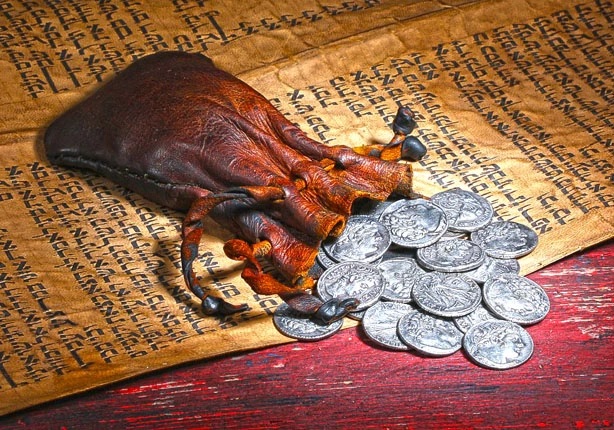
12 I told them, “If you think it best, give me my pay; but if not, keep it.” So they paid me thirty pieces of silver.
13 And the Lord said to me, “Throw it to the potter” — the handsome price at which they valued me! So I took the thirty pieces of silver and threw them to the potter at the house of the Lord.
Thirty silver pieces? Isn’t that the price Judas got for Jesus? Is there a connection? We’ll need to see what this means in Zechariah first, to understand what Matthew 27:3-10 makes of it.
Continue reading “Thirty pieces of silver (Zechariah 11:12-13)”
Why are we living under leaders who fight each other (wars) and crush their people (injustice) if God is on the throne?
Open Zechariah 11.
The Lord will be king over the whole earth (Zechariah 14:9). That’s the theme of Zechariah 10–14, and what an astounding promise! This is the gospel Jesus proclaimed, the good news we believe.
But some find it hard to believe there’s a God taking care of us when there is so much injustice, so much evil in the world. Zechariah 11 faces that issue. God asks the prophet to role-play what our human shepherds do: acting out of self-interest rather for the justice of the eternal Shepherd.
We explained how the shepherd metaphor was used for gods and kings in the Ancient Near East. That makes it the perfect term for addressing the inconsistency between what the Shepherd wants versus what the shepherds are doing. All the wars of history — including the suffering of God’s people at the hands of the nations — it all arises from the disconnect between the Shepherd and the shepherds.
Continue reading “Is God a good Shepherd if we have bad shepherds? (Zechariah 11)”
Zechariah provides the background for understanding Jesus as our shepherd.
“The Lord is my Shepherd,” said King David. “I am the good shepherd,” said Jesus. Are there bad shepherds? What’s this shepherd imagery about?
Shepherd is a keyword in Zechariah 10–14, a passage Jesus and the Gospel writers kept alluding to. What was Zechariah saying about the shepherd? How does this help us understand Jesus?
















 Seeking the kingdom