This podcast (26 min) covers the topics blogged from Genesis 5:
Category: Hermeneutics
What about the ages in Genesis 5?
Is Genesis 5 saying that some individuals lived have for almost 1000 years? That doesn’t match anything in our world today or in ancient history. Is what it sounds like to us what it meant to them? Or did it mean something to them that isn’t obvious to us? Honestly, I don’t know. At this point, I’m uncertain what to make of it.
The relationships in Genesis (Genesis 2:4)
This verse shows us how to recognize the family stories in Genesis, framing our identity in relation to God and to each other.
It’s all about our relationships with God and each other. Genesis 2:4 introduces us to the structure of the book, how the stories of the key people fit together, and our relationship to the Lord God.
Discerning where each new section begins is crucial to understanding any text. You won’t believe how easy this is in Genesis. Each new story begins with the word tô·lē·ḏôṯ in Hebrew. It means a family story, the account of a family’s origin and the descendants who carry on the family line.
Here are all the family stories (tôlēḏôṯ) identified in Genesis:
Continue reading “The relationships in Genesis (Genesis 2:4)”
How to approach Genesis 1
Why do people disagree over how to read Genesis 1?
If you missed Ariana Grande’s most popular song last year, tell me what she means:
I didn’t think you’d understand me
How could you ever even try? …
We can’t be friends …
— Ariana Grande
Was she breaking up with a guy because he didn’t understand her? If you keep listening, it’s the other way around. The refrain is, “I’ll wait for your love.”
Even best friends misunderstand each other. We make assumptions about what the person is saying. We hear part of the message and miss the main thing. We don’t connect the words with yesterday’s conversation.
The chance of misunderstanding is greater when we don’t know someone well. If the person is from another culture, or another language, or another time, we’ve got work to do to understand who they are, what they’re saying, and what they mean.
All those issues are present when we come to the Bible. All sixty-six books come to us from another culture, another language, and another time. We misunderstand them when we read them through Western eyes, though the dynamics of our culture and the assumptions of our time.
That’s why people divide over how to read Genesis. We misunderstand it when we expect it to answer our questions about science and history, instead of hearing what it is talking about. Gordon Wenham expressed it well:
How do the Prophets apply to us?
Did the Old Testament prophets describe current events, things happening in our lifetime?
There’s no question the Prophets spoke into specific times, addressing specific events. For example, this marks a major turning point in the Book of Isaiah:
When faith is a struggle (Hebrews 10:37–39)
In this series, we’ve talked about losing faith, changing faith, searching for faith, and finding faith.
Habakkuk 2:4 underpins several NT discussions of faith: the just shall live by his faith (KJV) or the righteous person will live by his faithfulness (NIV). We’ve seen how this applies to Jesus’ faith, gospel faith, our faith and our struggle with evil.
Hebrews also quotes Habakkuk 2:4, right before the big “faith” chapter (Hebrews 11). But the quotation in Hebrews is problematic, different how Paul quotes it in Romans 1:17 and Galatians 3:11.
The differences are due to translation. As a sermon delivered in Greek, Hebrews uses the Septuagint (Greek translation of the Old Testament) just as most preachers use our English translations for sermons each Sunday.
But how are we to respond if Hebrews relies on a mistranslation? Does that mess with our faith?
Continue reading “When faith is a struggle (Hebrews 10:37–39)”
Of David (Psalms)
What does it mean when you see “Of David” in the heading of a Psalm?
What does Of David mean in the heading of a psalm? Is it from David, or about David, or …? Or are these headings later additions that we should just ignore? Your answer affects how you hear the psalm.
Reading Psalms in context
Each Psalm is set in Israel’s story, within the macro-story of God’s kingdom.
I love the Psalms. They help me voice my hopes and struggles to God. It’s so personal: the word I is there some 800 times, about 5 times a Psalm.
But there’s a bigger story in the Psalms too. I miss that global scope of God’s activity if I treat every I as me, the reader. The very first I in Psalms is God, and he says, I have installed my king on Zion, my holy mountain (2:6).
In the Psalms we discover ourselves as the human community in God’s care. We present our struggles to the sovereign Lord who leads us. We celebrate his power over us, his enduring sovereign authority. At the heart of the Psalms is the declaration, The Lord reigns!
Interpretating well
The best interpretation of what God says is to be the community he leads.
I don’t have a set of rules to give you for the science of interpreting Scripture. As every writer knows, language is not a science; it’s an artform. Well, lawyers may try to disambiguate every loophole and kill every misinterpretation, but Scripture is more like poetry communicating life. God’s life is the source and sustenance of our life together.
When we communicate, we’re not just sharing information. We’re sharing ourselves. That’s why speaking to a large group is so scary: we feel vulnerable sharing ourselves with so many.
That’s the promise and power of Scripture: God communicates himself with us. The words of life are not in the text; the text leads us to the one who speaks (John 5:39-40).
That’s how Jesus used words: The words I have spoken to you are [my] spirit, [my] life (John 6:63). And, oh my, how vulnerable Jesus felt giving us his life in this chapter!
So, two questions. How did we end up with so many interpretations? How can we do better?
“Eagles Annihilate Dockers In Derby”
Being aware of how we use language helps us understand each other. And Scripture.
No, that’s not today’s headline. But it will be familiar if you follow AFL (Australian football).
On 15 August 2021, Fremantle Dockers defeated West Coast Eagles (70-64). It was the first time Freo won in 12 derbies (clashes of the local teams). In one of the 2019 derbies, the Eagles almost quadruples the Dockers’ score after Fremantle went on a spree of kicking behinds: 2.19 (31) to 19.8 (122).
This language is so familiar to us that we don’t even consider that “kicking behinds” could have other meanings. But imagine a researcher in 2000 years trying to make sense of our history. Our news headlines have been preserved in a database, but they know nothing of AFL.
So, they read the headline, and consult their English lexicon for the meaning of the words. It tells them that an “eagle” is a large predatory bird, and a “docker” is someone who works on the docks loading and unloading ships. They wonder if “Derby” is a port. And there it is on their maps — on the northwest coast of Australia. Can you imagine the picture forming in their minds of what the headline means?
This is exactly the kind of problem we face when reading the Bible. The Bible is not some kind of encyclopaedic wiki on spiritual truth. It’s a record of God interacting with humans in various times and places, so it’s a revelation of God: his faithful character and unswerving purposes for us. But since it’s rooted in particular people struggling in particular settings, we cannot understand what it means if we misunderstand what it meant for them.
A cleansed, non-prophet kingdom? (Zechariah 13:1-6)
Interested in seeing the gospel in the Old Testament? This example from Zechariah 13 shows how to (and how not to).
Open Zechariah 13:1-6.
The ideal kingdom is a wise king with a responsive community. Zechariah’s hope is for Israel’s failed kingdom to be restored after being exiled and dominated by foreign powers. He anticipates what life could be like on that day (13:1, 2, 4).
King and kingdom are reconciled as God gives them a spirit of grace and supplication, and they respond by seeing how they hurt him — looking on the one they have pierced (12:10). They stabbed God’s heart by rejecting his kingship, giving themselves to other rulers and their gods. This has been Zechariah’s core message: Return to me, and I will return to you (1:3).
So, on that day when they turn back to God’s kingship, God cleanses the house of David — the kingship God sacked because they were self-serving. On that day, God cleanses the inhabitants of Jerusalem — the people who gave themselves to other rulers and their gods.
Based on the Torah, Israel was to be a nation under God’s leadership. Their sovereign gave them his laws and defined how to remain ritually pure in his presence. Sin or impurity could make them unclean, so he provided cleansing rituals (e.g. wash occurs 35 times in Leviticus). So when they turn back to God, Zechariah declares that God will open a fountain to cleanse his people, so they’re devoted to him alone:
Continue reading “A cleansed, non-prophet kingdom? (Zechariah 13:1-6)”
How Jesus fulfils the prophets (Zechariah 8)
With a chapter never quoted in the NT, we see how Jesus fulfilled what God promised through the Prophets.
The hope Jesus proclaimed was deeply rooted in the promises of the prophets. Matthew keeps telling us that Jesus fulfilled the prophets, using phrases from Zechariah far more than we do today.
Many of us struggle to make sense of how the NT writers used the prophets. Read Zechariah in context, and it may not sound like predictions. For example, the blood of the covenant in Zechariah 9:11 seems to refer back to the Sinai covenant (Exodus 24:8), yet Jesus used the phrase for his Last Supper (Matthew 26:28).
Maybe our understanding of “context” is too narrow. You probably know to check a few verses either side of a quotation, so as not to take it out of context. In a limited sense, that’s true. But for Jesus and the New Testament writers, context was much broader — their place in the story of God.
When Jesus announced the good news of the kingdom, his context was the Jewish world that had not been a kingdom since the exile. Most of them lived in other countries, scattered like sheep without a shepherd. That’s how Zechariah had described them 500 years earlier (Zechariah 10:2; 13:7 etc), and it still described their context in Jesus’ day (Matthew 9:36; 10:6; 15:24).
Jesus fulfilled the prophets not merely by doing some particular thing they predicted. That happened, but it was far more: everything God promised to restore was finally fulfilled in his Anointed. That’s the scope of what Jesus fulfilled: All the promises of God find their Yes in him (2 Corinthians 1:20).
So, let’s take a chapter the NT writers never quoted. How is Zechariah 8 fulfilled in Christ?
Continue reading “How Jesus fulfils the prophets (Zechariah 8)”
David’s Lord (Matthew 22:41-46)
Understanding the Bible is all about understanding the relationships. Jesus shows us how with his puzzle about the people in Psalm 110:1.
My wife loves relationships movies. She’s not looking for action scenes, spy plots, or superheros bringing everybody to heel. She loves stories that explore how people relate.
I think that’s how Jesus heard the Bible. Academics can focus on the form and structure of the text or making theology systematic, but for him it was all about relationships.
Matthew 22 gives example after example where his interpretation was relational:
- God’s people live because I AM. Knowing Scripture means knowing God, his life-giving power (see on 22:29-32).
- Loving God and loving people — those relationships are the whole Bible (the Law and the Prophets) (see on 22:34-40).
- To understand a Psalm, explore the relationships between the people (22:43-45).
Now, I know this isn’t how we usually read Scripture. Jesus’ approach sounded just as foreign to the Pharisees as it does to us. Can we learn the relational hermeneutic Jesus used? In this post, we’ll take the third example (based on Psalm 110) as our tutorial.
Notice the question Jesus asks:
Continue reading “David’s Lord (Matthew 22:41-46)”The God who raises the dead (Matthew 22:31-32)
“I am the God of Abraham” proves the resurrection?
Like you, I want to understand Scripture better, so we can live it well. It matters, because we’re living in God’s story. One way to learn is to watch how Scripture handles Scripture (i.e. intertextuality informs hermeneutics).
For example, in Matthew 22:31 Jesus quotes this text to convince his opponents about the resurrection:
Exodus 3:6 I am the God of Abraham and the God of Isaac and the God of Jacob.
Huh? How does that verse prove the resurrection? I might have gone for something like this:
Continue reading “The God who raises the dead (Matthew 22:31-32)”Handling Scripture as Jesus did (Matthew 19:4-9)
Why did Jesus privilege some parts above others?
Disciples learn by seeing what the Master does. I especially enjoy seeing how Jesus handled Scripture (hermeneutics). Surprisingly, he privileged some parts above others.
When they asked him about applying Deuteronomy 24 (divorce law), Jesus said this isn’t what God always intended. It was a concession God gave them, because of hard hearts. He led them back to the beginning of the story (Genesis 1–2) to discover what God had always intended.
Many things in Scripture are like that — not God’s ideal. He’s managing broken people, and he has the sense to lead us step by step, not demanding everything from us at once. God accommodates flawed heroes and flawed relationships, on the way to restoring what he intended in the beginning.
Can you think of other examples where we could apply this hermeneutic?
Continue reading “Handling Scripture as Jesus did (Matthew 19:4-9)”Reading together
Before the printing press, few people had a Bible of their own. It was a shared book. People read together. The Old Testament was the Jewish community’s story. New Testament letters were for churches. The Gospels were communal memories, reflected in the way the Synoptics use identical phrases to tell Jesus’ story.
Then the printing press gave us each a Bible of our own. Reading it as a private book, we fragmented into 40,000+ denominations. There are people in our culture who promote the notion that a text can mean whatever a reader wants (reader-response theory).
Today we tend to read the Bible alone. I bring the Bible into my private world, searching for spiritual guidance for my life. I identify each character with my struggles, glossing over the bigger story of the faithful Father who reigns across the families and generations. Almost imperceptibly, I am the centre of my universe.
Reading well
A simple tip, so you don’t make the Bible say what it never said.
What an amazing book! You want to explore it well so you can live well, but you’re not sure if you’re on the right track? This post is for you.
Are the Psalms messianic?
Do the Psalms tell us about Jesus? Are these verses about Christ?
Psalm 22 1 My God, my God, why have you forsaken me? … 16 They have pierced my hands and feet.
Psalms 118 22 The stone the builders rejected has become the cornerstone.
The New Testament writers thought so. So did the church fathers. Were they right? Or were they bending texts to fit their beliefs? What did David intend? Does authorial intent define the meaning? Or is meaning in the ear of the hearer, whatever the reader wants it to mean?
When the church fathers used the Psalms this way, the Jewish leaders were mortified. They pointed out that no one read the Psalms like this until after Jesus died, so the Christians were merely imposing their own meaning on Jewish literature.
Should we be seeing the Messiah in the Psalms? Everywhere? Nowhere? In a few cases? What do you think?
How to read Psalms
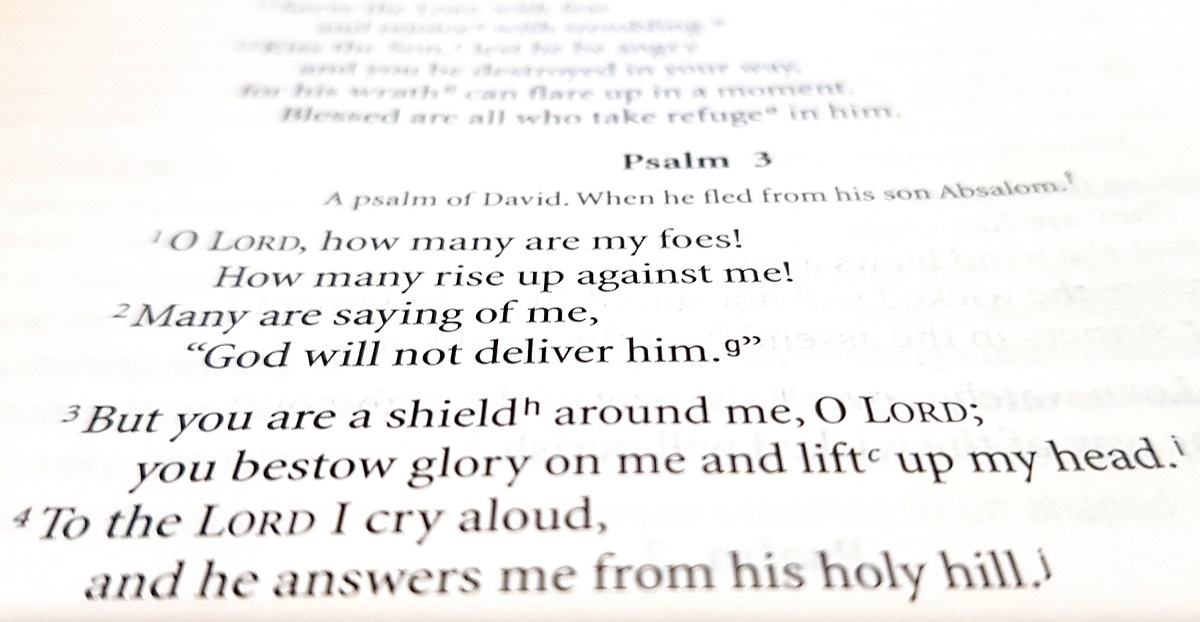
This post is longer than normal. It walks you through how to process the Psalms, with Psalm 3 as the example.
Open Psalm 3.
How do you read Psalms? We love the first one: a fruitful tree by the stream. Psalm 2 is more confronting, but we like to read about God’s anointed Son. Then Psalm 3 is about facing enemies. What do you do with that?
If you don’t have enemies, perhaps you skip it and try to find something more joyful? Or perhaps there is someone who’s making your life difficult, so you read on … until you reach verse 7. Are you really supposed to pray, “God smack them in the face and smash their teeth in?”
If you ever end up in court for punching someone, please don’t offer as your defence, “The Bible told me to.”
There is a better way to read the Psalms. They aren’t about “me and God.” You won’t get far if you approach them with the attitude, “What’s in it for me?” You need to ask, “What has this meant for God’s people before me?”
Whose voice?
Who is the me in Psalm 3? No, it’s not you, the twenty-first century reader. Who poured out this graphic lament about the enemies arrayed against him? Any ideas?
Grace is a generous king (Ephesians 4:7–10)
Divine benevolence beyond imagination.
If you want to handle Scripture well, you’ll be very interested in how the New Testament writers handled the Old. What they do can seem puzzling, but it’s so informative.
Consider this example where Paul seems to misquote a Psalm: Continue reading “Grace is a generous king (Ephesians 4:7–10)”