Most popular posts of 2021

Did you miss any of these?

So much is beyond our control, “the best laid schemes o’ mice an’ men.” It shatters our illusions of being in control, triggering mistrust of our leaders. Turns out neither they nor we know where we’re going, let alone get there.

I’m finding encouragement from a guy whose life was ebbing away in isolation, yet kept his vision on the one who has our destiny sorted:  I know whom I have believed, and I am convinced that he is able … (2 Timothy 1:12).

There’s only one King of Kings. Serving as his agents in a suffering world is the meaning of our lives.

If you’d like something full of hope about where he’s leading us, these were our most-read posts in 2021:

Continue reading “Most popular posts of 2021”

Wonderful Counsellor (podcast) (Isaiah 9:6)

Why did the wonderful counsellor begin with the place that went dark first? Can his mediation resolve the violence and oppression to restore peace to God’s world?

From cards to cantatas, Isaiah 9:6 is part of Christmas. The child who is born, the son who is given is recognized with throne-names like Wonderful Counsellor.

What did wonderful counsellor mean in Isaiah’s time? How does it relate to Jesus?

Continue reading “Wonderful Counsellor (podcast) (Isaiah 9:6)”

The Lord’s Supper challenges culture (1 Corinthians 11:17–34)

Why were the Corinthians “doing more harm than good” when they met?

Why do churches meet? If we’re not clear what we’re meeting for, we may do more harm than good:

1 Corinthians 11:17-21 (NIV)
17 Your meetings do more harm than good. 18 In the first place, I hear that when you come together as a church, there are divisions among you …
20 When you come together, it is not the Lord’s Supper you eat, 21 for when you are eating, some of you go ahead with your own private suppers. As a result, one person remains hungry and another gets drunk.

The heart of what’s wrong here is competition instead of community.

This isn’t unique to the church. From the Parents and Citizen’s committee of the local school to the political parties that want to run the country, competing groups are always after the best outcome for their faction. It’s how the politics of power works.

But the church embodies the culture of a different kingdom. We’re doing more harm than good if our gatherings reinforce existing culture instead of the king whose authority comes from the cross.

Continue reading “The Lord’s Supper challenges culture (1 Corinthians 11:17–34)”

The new covenant meal (podcast) (1 Corinthians 11:23–26)

A new covenant? How did Jesus’ bloodshed establish a new covenant? Who are the parties? Why a new covenant? Could a previous covenant shed light on this one?

In the Ancient Near East, a national covenant defined who was in power. That’s what the Sinai covenant achieved: a people rescued from slavery became the first nation on earth to live under God’s reign, and the covenant that was celebrated with a meal (Exodus 24:7-11).

How did the new covenant establish God’s reign in Christ? What is it we’re proclaiming in this meal?

Continue reading “The new covenant meal (podcast) (1 Corinthians 11:23–26)”

The covenant meal (1 Corinthians 11:23–26)

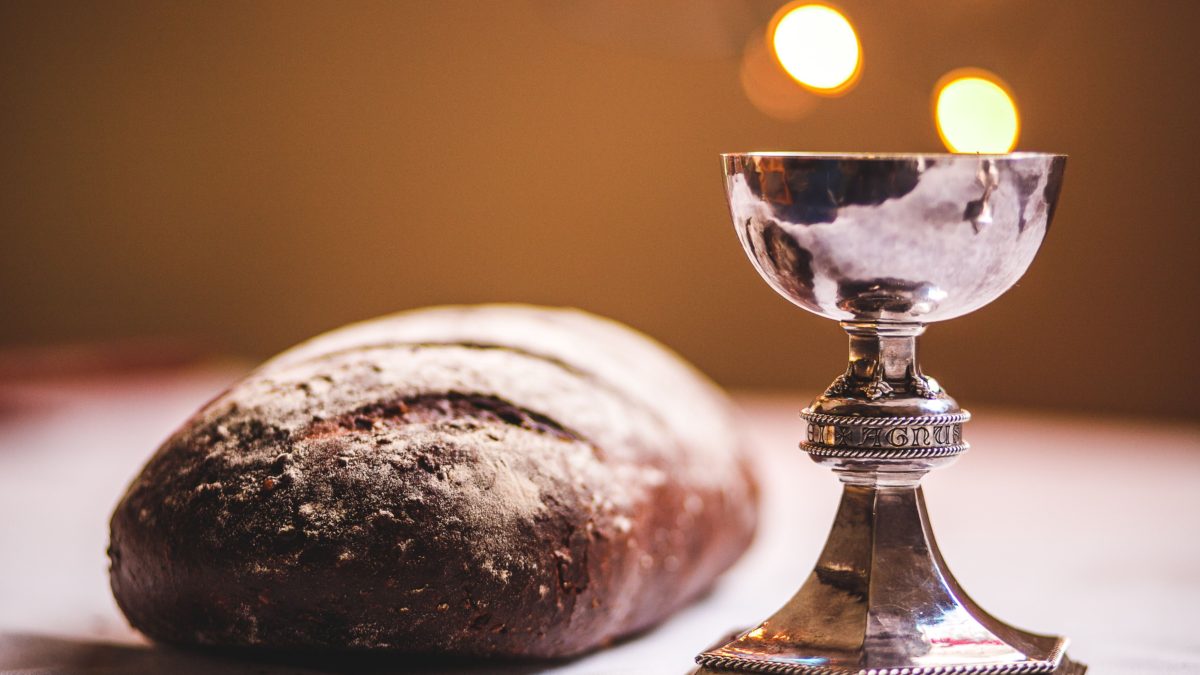
Communion is a new-covenant feast. How does the body and blood of the Christ create a covenant between heaven and earth?

If your church celebrates the Lord’s Supper, you’ll be familiar with this:

1 Corinthians 11:23–26 (NIV)
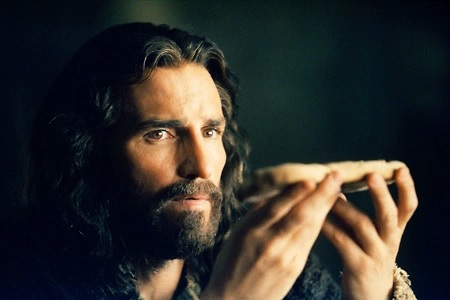
23 For I received from the Lord what I also passed on to you: The Lord Jesus, on the night he was betrayed, took bread, 24 and when he had given thanks, he broke it and said, “This is my body, which is for you; do this in remembrance of me.”
25 In the same way, after supper he took the cup, saying, “This cup is the new covenant in my blood; do this, whenever you drink it, in remembrance of me.” 26 For whenever you eat this bread and drink this cup, you proclaim the Lord’s death until he comes.

We hear this so often we may not see how counter-cultural it is. When we celebrate our Lord, we’re proclaiming the king who gave his life to re-establish the covenant relationship between heaven and earth.

Those verses begin and end by proclaiming Jesus as kyrios — Lord. A kyrios in Greek culture was a master or a ruler. The head of a business was the kyrios: the master, the lord of the business. The head of the Empire was a kyrios: Caesar expected you to call him your lord.

But if you saw a convicted criminal hanging on a cross beside the road, you would not normally call him kyrios. The crowd would be more likely to call him Loser than Lord.

In what sense is Jesus our kyrios, the Lord?

Continue reading “The covenant meal (1 Corinthians 11:23–26)”

When the last man falls (Matthew 26:69-75)

Seeing no alternative, Peter disowned his king. Jesus never gave up on him.

Why did Peter deny Jesus? Was he just sitting at the wrong fire, in a crowd where he didn’t have the gumption to admit he was Jesus’ follower? That isn’t how this story works in Matthew’s Gospel.

Peter was the first to acknowledge Jesus as the Christ, God’s anointed leader (16:16). Jesus blessed him, but realized Peter had no idea of the conflict ahead. Peter’s denial began when he said, No Lord! This will never happen to you! Denying that Jesus would die at the hands of the Jerusalem leaders placed Peter on the enemy’s side (16:21-23). Peter could understand taking up his sword and kill to save his king (26:51-52), but he could not understand taking up his cross to follow the king into death to save his realm (16:24-28).

Once Jesus removed fight from the agenda, flight was the only option his followers could see. That’s why, All the disciples deserted him and fled (26:56).

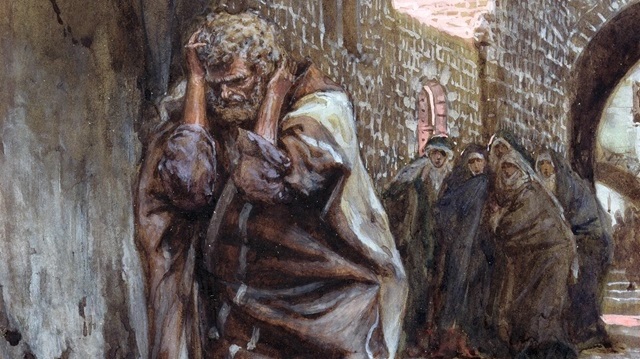
Peter could make no sense of what was happening, but he couldn’t stay away either. Peter followed him from a distance … to see how it would end (26:58). That’s the reason Peter was there, trying to blend in with Jesus’ antagonists. That was never going to work, of course. A lumbering fisherman sprouting Galilean phrases was as inconspicuous as an Aston Martin in a spy movie.

Continue reading “When the last man falls (Matthew 26:69-75)”

Why was Jesus accused of blasphemy? (Matthew 26:59–66)

How could Jesus be tried and condemned for the sin of blasphemy?

“Speak against me, and you speak against God!” That kind of manipulation is common from cults to Catholicism, from micromanagers to megachurches. That’s what motivated Caiaphas to tear his garments at Jesus’ trial with the accusation, He blasphemed! (26:65)

Continue reading “Why was Jesus accused of blasphemy? (Matthew 26:59–66)”

“Tell us if you are the anointed ruler” (Matthew 26:57–68)

Jesus’ trial before the Sanhedrin was all about whether he claimed to be king.

Why was Jesus called to stand trial before the Jerusalem Council?

It won’t do to say, “Well, Jesus claimed to be the second person of the trinity (Son of God), and the high priest thought that was blasphemous.” The notion of a triune God was not formulated until much later. The high priest was not investigating a Christian dogma when he said, I adjure you by the living God, tell us if you are the Christ, the Son of God. (26:63 ESV).

Peter had used those titles: Christ, Son of God (16:16). We saw that the Gospel writers treat the two phrases as meaning the same thing (epexegetical). The Christ is the anointed ruler who represents on earth the reign of the heavenly sovereign. In that sense, he is the son proclaimed by the eternal sovereign. That’s what son of God meant to the high priest. It was the language of kingship (Psalm 2:2, 7), the language of God’s promises to David (1 Chronicles 17:13).

But the kingship had failed. The final Psalm in Book III laments the disconnect between God’s amazing promises and their experience of the failed kingship:

Continue reading ““Tell us if you are the anointed ruler” (Matthew 26:57–68)”

Why did Jesus have to die? (Matthew 26:47-56)

How did Jesus’ death “fulfill the prophetic Scriptures?” Here’s the explanation he gave in Gethsemane.

Fight or flight? Many kings have faced that choice. In a field just outside his capital, the true king rejected both options. Neither would bring peace to a divided world.

If you don’t flee and you don’t fight, you could die. Not very attractive, but it is an option: stay and die.

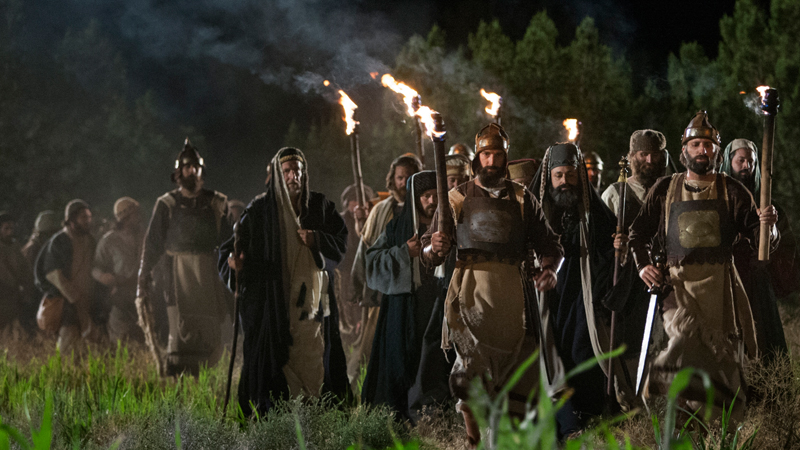
Instead of taking flight, Jesus stayed in Gethsemane, consulting his Father, the architect of human history. He triple-checked for any other alternatives (26:36-46). When the crowd with swords and clubs arrived to take him, he rejected the fight option too.

Matthew doesn’t name Peter as the disciple who unsheathed a dagger. It’s too late for flight. He sees no option but to fight for his king. He swings his sword. The high priest’s servant sees it coming and drops his head to one side. The blow aimed at his neck slices off his ear.

The king orders him, Put your sword back in its place! All who take the sword will destroy themselves with the sword.

What astounding insight! Jesus wasn’t merely saying that those who rely on weapons for survival probably won’t. He said the very act of choosing weapons to kill humans destroys our own humanity (ἀπολοῦνται = future indicative middle).

Ask returning soldiers who’ve seen killing whether Jesus is right. Ask them how many friends they’ve lost to the spectrum from shellshock to suicide. War destroys more than the enemy.

But what sort of option is stay and die? Is that what the Scriptures required of him? It’s not what previous kings had chosen.

Continue reading “Why did Jesus have to die? (Matthew 26:47-56)”

Dark night without answers (Matthew 26:36-46)

Gethsemane isn’t the end, but it sure can feel like it.

Every fibre of his being wanted to run. He wouldn’t last twenty-four hours if he stayed. Grief, anxiety, debilitating distress was killing him.

One of his friends had turned traitor, agreeing to hand him to his enemies (26:20). His other friends didn’t understand, asleep while he faced the dark night of the soul. Though he felt like running for his life, Jesus spent his last moments of freedom facing his Father.

When I’m depressed or distressed, the Psalms advise me to hope in God … my Saviour and my God (Psalms 42:5, 11; 43:5). We’ve heard that nothing is impossible with God. Facedown in the dirt in abject submission, Jesus prayed, My Father, if it’s possible, let the cup pass me by (Matthew 26:39).

Why was God handing him a deadly chalice? It was tearing him apart as he prayed, If it’s what you want, I’ll take it.

Silence.

Continue reading “Dark night without answers (Matthew 26:36-46)”

Unjustly struck down (Matthew 26:31-35)

How did Jesus handle the rejection he faced?

My feelings affect what I hear from others. When we feel guilt, we hear condemnation. Even from Jesus.

“You will all desert me” is the New Living Translation of Matthew 26:31. It sounds like committing apostasy, and it has been heard that way since the second century.

But desert is an active word, and Jesus used the passive voice. He didn’t say they would fall away from the faith; he said they would be felled by the events of that night.

Jesus wasn’t blaming them. He was blaming God:

Continue reading “Unjustly struck down (Matthew 26:31-35)”

What did Jesus sing? (Matthew 26:30)

The first worship song in the New Testament

Here’s the only record of Jesus singing:

Matthew 26:30 And having sung, they went out to the Mount of Olives.

Singing would be unremarkable today. Churches spend lots of time doing it. But this (|| Mark 14:26) is the only time the Gospels mention Jesus or his disciples singing.

So, what would they sing? I mean, it wasn’t from a Wesleyan hymnbook or a Hillsong stream.

Continue reading “What did Jesus sing? (Matthew 26:30)”

With you in my Father’s kingdom (Matthew 26:29)

What was Jesus referring to when he spoke of celebrating anew with them in his Father’s kingdom?

Closing his Last Supper, Jesus said, I tell you the truth, from this moment I will not drink the vine’s produce with you until the day when I drink it with you anew in my Father’s kingdom (Matthew 26:29).

What did he mean? According to some communion talks, Jesus was referring to the big banquet at the end of time when everyone is under God’s authority. But that doesn’t really work: within a few days, Jesus was eating with them again (Luke 24:30, 43; John 21:5-13; Acts 1:4).
Continue reading “With you in my Father’s kingdom (Matthew 26:29)”

Zechariah’s vision of God’s reign (Zechariah 14:4-21)

The Lord will be king over the whole earth (Zechariah 14:9)

A restructure is common when a new leader takes office. Zechariah’s final chapter envisions a restructure of creation as it comes under divine sovereignty. The heart of the chapter is this: The Lord will be king over the whole earth (14:9). And changing the king changes the kingdom.

In an alien world, Star Trek’s Spock would say, “It’s life, Jim, but not as we know it.” Zechariah is not seeing an alien planet; he’s seeing the removal of everything alien to God’s intentions for life on earth, the terraforming of our planet.

With impressionistic brushstrokes, Zechariah paints an image of God’s reign transforming everything:

Continue reading “Zechariah’s vision of God’s reign (Zechariah 14:4-21)”

Great authority for a great commission (Matthew 28:18-20)

The king’s authority sets the servants’ task.

The great commission begins with all authority. Without understanding who is king and how he uses his authority, we’re likely to misuse that authority.

We’ve heard that it was said:

Go into all the world and convert everyone to Christianity.

What he said was more like this:

All authority in heaven and on earth has been entrusted to me. On that basis, everywhere you go you are to train the nations, plunging them into the leadership given by heaven for the earth: the authority of the Father, his Son, and the Holy Spirit.
Your role is training the nations to obey what their king has commanded. And I promise you I will always be with you my servants, until the goal of the era is fully accomplished (i.e. heaven’s authority is fully restored to earth).
— paraphrase of Matthew 28:18-20.

Begin with his authority, and his commission takes meaningful shape.

The authority of the Christ (28:18)

Continue reading “Great authority for a great commission (Matthew 28:18-20)”

What is a Christian? (podcast) (Romans 12:9-21)

What does it mean to be a Christian?

Writing to Rome, Paul spent eleven chapters explaining who Christ is in relation to us, and then five explaining who we are in relation to each other under Christ’s leadership. Short answer: Christians are the community in Christ. Our identity derives from the leader God appointed for us.

This podcast draws on the transitional chapter of Romans, in fresh translation. Recorded at Riverview Church’s Joondalup campus, 15 August 2021 (34 minutes).

Related posts

You are the Christ (podcast) (Mark 8:27-35)

Open Mark 8:27-35 (ESV).

What do we mean when we say Jesus is the Christ? Is it merely part of his name? Or did Peter have something more in mind when he declared Jesus to be the Christ?

This is no minor matter. It goes to the heart of the Christian faith. It needs to be discussed in our churches, since Jesus’ identity and mission defines our identity and mission. So, how do we teach on this for a Sunday congregation?

This podcast (24-minutes) is from the message delivered to Riverview Church’s Joondalup campus on 8 August 2021.


Continue reading “You are the Christ (podcast) (Mark 8:27-35)”

Divine sovereignty and human suffering (Zechariah 14:1-5)

Puzzled over how to understand God’s sovereignty? It’s the hope of a suffering world.

Zechariah’s final chapter extends astounding hope in a puzzling framework.

Continue reading “Divine sovereignty and human suffering (Zechariah 14:1-5)”

Strike the shepherd (Zechariah 13:7-9)

Why was the shepherd of God’s people struck? Why did Jesus relate Zechariah’s message to himself and the scattering of his little flock?

Open Zechariah 13:7-9 and Matthew 26:31-32.

The night he was arrested, Jesus expected his friends to abandon him. He knew they would because the prophets said so.

Matthew 26:31 Jesus told them, “This very night you will all fall away on account of me, for it is written: ‘I will strike the shepherd, and the sheep of the flock will be scattered.’” (NIV)

Reading Zechariah 13, it’s not immediately obvious why Jesus would apply this to himself. To make sense of how Jesus understood the text, we need to read the prophets in the context of the story they were telling.

Who was “my shepherd” in Zechariah 13:7?

Continue reading “Strike the shepherd (Zechariah 13:7-9)”

A cleansed, non-prophet kingdom? (Zechariah 13:1-6)

Interested in seeing the gospel in the Old Testament? This example from Zechariah 13 shows how to (and how not to).

Open Zechariah 13:1-6.

The ideal kingdom is a wise king with a responsive community. Zechariah’s hope is for Israel’s failed kingdom to be restored after being exiled and dominated by foreign powers. He anticipates what life could be like on that day (13:1, 2, 4).

King and kingdom are reconciled as God gives them a spirit of grace and supplication, and they respond by seeing how they hurt him — looking on the one they have pierced (12:10). They stabbed God’s heart by rejecting his kingship, giving themselves to other rulers and their gods. This has been Zechariah’s core message: Return to me, and I will return to you (1:3).

So, on that day when they turn back to God’s kingship, God cleanses the house of David — the kingship God sacked because they were self-serving. On that day, God cleanses the inhabitants of Jerusalem — the people who gave themselves to other rulers and their gods.

Based on the Torah, Israel was to be a nation under God’s leadership. Their sovereign gave them his laws and defined how to remain ritually pure in his presence. Sin or impurity could make them unclean, so he provided cleansing rituals (e.g. wash occurs 35 times in Leviticus). So when they turn back to God, Zechariah declares that God will open a fountain to cleanse his people, so they’re devoted to him alone:

Continue reading “A cleansed, non-prophet kingdom? (Zechariah 13:1-6)”