Original good (Genesis 1–4)

Why do we start with “original sin” when the Bible starts with “original good”?

There’s more than one way to tell a story. Theology has its jargon. It often starts with original sin, the result of the fall. These aren’t phrases from Scripture, though Paul does say that one person got us into trouble and one person can get us out (Romans 5:12; 1 Corinthians 15:21).

I love the Christological focus at the heart of everything Paul writes, but Genesis doesn’t use our theological language for Adam’s story. It doesn’t start with original sin. In fact, the first three chapters don’t mention sin at all. It talks about good. A lot. Fifteen times.

Genesis starts with original good. What would change if we told our story this way?

Let’s see how Genesis inspires us to understand the good world and our place in it.

Continue reading “Original good (Genesis 1–4)”

Does the universe repay us as we deserve? (Genesis 42:21–28)

“What is this that God has done to us?” (Genesis 42:28)

People expect to be rewarded for doing right, and to suffer when they harm others. Religions teach that this will happen in the next life if not in this one, whether that’s understood as eternity or reincarnation. Does the Bible teach this?

You can certainly find cases of people who felt like this. Joseph’s brothers believe their past has caught up with them when they find themselves in an Egyptian prison:

Continue reading “Does the universe repay us as we deserve? (Genesis 42:21–28)”

Joseph’s greatest test (Genesis 42:1–20)

How did Joseph handle the most difficult temptation of his life?

When we idealize our heroes, we diminish their struggles. Joseph’s temptations were real, but Mrs Potiphar wasn’t the big one. His greatest test was his brothers — what he’d do to them once he had the power to give them what they deserve.

Continue reading “Joseph’s greatest test (Genesis 42:1–20)”

Joseph’s love story (Genesis 41:44-52)

Who was Asenath? Why did she marry Joseph? What do we learn from their story?

Did you know that Joseph married an Egyptian?

Genesis 41 (NIV)
45 Pharaoh gave Joseph the name Zaphenath-Paneah and gave him Asenath daughter of Potiphera, priest of On, to be his wife. …
50 Before the years of famine came, two sons were born to Joseph by Asenath daughter of Potiphera, priest of On.

Joseph is an amazing character. Despite being catapulted to power from prison, Joseph is one of the few not corrupted by power. But his lifestyle choices in exile still present problems for observant Jews.

Continue reading “Joseph’s love story (Genesis 41:44-52)”

Governing with God (Genesis 41)

Do politics and religion mix? How did Joseph make it work with Pharoah?

From prison to palace in a single day! Are you encouraged by Joseph’s story? It’s more than personal encouragement. It’s God doing something enormous, global even. What does Joseph’s story teach us about the kingdom of God?

God gave the king of Egypt a dream (Genesis 41:1). Is religion meant to influence politics? Aren’t church and state too explosive to mix? I guess God’s not very good at staying out of the political arena.

So how does the kingdom of God relate to the kingdoms of the world? The heavenly sovereign has wisdom for earthly rulers. He’s the king above all kings. But how God does this is crucial:

  • We misrepresent God when we withdraw from politics, as if God has no interest in the secular domain.
  • We misrepresent God when we engage with the fights and factions of earthly politics, to force our will on the secular world.

Is there a third way? Joseph brought God’s wisdom to the secular world. In a land far from family and faith, with a meteoric rise from prisoner to prince, Joseph represented God well in Egyptian politics. Can we learn from him?

Continue reading “Governing with God (Genesis 41)”

Living in grace and disgrace (Genesis 40)

Joseph’s story shows us how God deals with injustice.

You’re in good company if you’ve noticed that life isn’t fair. Joseph had every reason to be bitter over how his brothers sold him out, and his boss falsely accused him. Prison walls offer no choices. Every morning Joseph wakes to this meaningless existence.

Others feel the same in this prison. Joseph finds meaning in caring for them. But one morning they’re more glum than usual, troubled by dreams.

Continue reading “Living in grace and disgrace (Genesis 40)”

Dreams in prison (Genesis 40:1–8)

“Then we’ll see what comes of his dreams,” his brothers said as they threw Joseph in a pit (37:20). He had big dreams of ruling the sun, moon and stars (37:9). Instead, we find him in a dungeon with no control over his own life, ordered to serve prisoners (40:4).

So, serving prisoners is what Joseph does. One morning a couple of them looked more dejected than ever. “Why the long face?” he enquires (40:7). Turns out they had dreams too.

Continue reading “Dreams in prison (Genesis 40:1–8)”

Finding God in an unjust world (Genesis 39)

How did Joseph cope with treachery and accusations from a sexual predator?

Role-reversal stories help us break down our stereotypes and cultural bias. As a boy, I was warned against seductive females like Potiphar’s wife, but I don’t remember being warned against mistreating women as the men of Genesis did: Pharaoh (Genesis 12:15), Abimelek (20:2; 26:8), and Hamor (34:2).

Maybe the real issue is power rather than gender. Those three guys were all kings or princes. And Potiphar’s wife held all the power while Joseph was merely a slave.

Women are devalued in patriarchal society. Judah’s mistreatment of Tamar isn’t resolved until he realizes that, even though she used her sexuality against him, She is more righteous than I (38:26).

So, rather than treating gender as the problem in the conflict between male and female, could we make some progress by identifying abuse of power as the real issue? The role-reversal story of Genesis 39 suggests that might be a productive approach.

What happens when the woman has all the power, and the male is her slave?

Continue reading “Finding God in an unjust world (Genesis 39)”

Was Judah fit to rule? (Genesis 38)

Why interrupt Joseph’s story with the scandal of Judah and Tamar?

Judah is quite the cad in Genesis 38. But why interrupt the story of Joseph with a scandalous story about Judah?

That’s the puzzle for modern readers. As one of them said, All commentators agree that ch. 38 clearly interrupts the flow of the Joseph story (Hamilton, The Book of Genesis, NICOT, 2:431).

It makes more sense if we listen to the narrator who labelled Genesis 37–50 as the generations of Jacob, not Joseph’s story. Jacob was setting up his family, and he intended Joseph to rule.

But wasn’t Judah supposed to rule? King David descended from Judah. Didn’t Jacob intend the lion from the tribe of Judah to receive the ruler’s sceptre? (49:9-10)

Yes, but let’s not jump there too quickly. There are issues with Judah’s character, issues that call into question whether Judah is fit to rule. Would you trust a leader who would sell his brother into slavery? (37:26). Genesis 38 gives us more reason to question Judah’s character.

Continue reading “Was Judah fit to rule? (Genesis 38)”

Was Joseph meant to rule his brothers? (Genesis 37)

Why did his brothers sell Joseph into slavery?

Genesis is the foundational story of the kingdom of God. It starts with all God’s creatures in the care of his human servants who live in his garden. When they rebel, God sets in motion his plan to bring everything and everyone back under his sovereign care, starting with a prototype kingdom through the family of Abraham, Isaac, and Jacob.

We saw how the different stages of this story are clearly marked by the tô·lē·ḏôṯ formula, the final one being, These are the generations of Jacob. (37:2). Observing these cues helps us avoid twisting the story into our own image.

But why is this Jacob’s story? People usually treat Genesis 37–50 as the story of Joseph. His name is mentioned 151 times, twice as often as Jacob/Israel (73 times). We’ve heard Jacob’s name more frequently in previous chapters (150 times in Genesis 25–36), so why does the narrator say we’ve now reached Jacob’s story?

Continue reading “Was Joseph meant to rule his brothers? (Genesis 37)”

Why is the first book in the Bible called Genesis?

You’ll know how the story fits together if you know why it’s called Genesis.

Genesis is a Greek word (γένεσις) meaning birth, how something came to be, the account of a family.

The Septuagint translators (c. 200 BC) used genesis to translate tô·lē·ḏôṯ — a Hebrew word meaning a record of descendants or successors. The narrator used this word at key points. Watch for it, and you’ll see how the book fits together.

Continue reading “Why is the first book in the Bible called Genesis?”

Pastoral care case: Genesis 16

Here’s a practical exercise in pastoral care, hearing people in their pain.

Wherever you care for people — family, small groups, churches, counselling — you’ll feel the whole gamut of emotions. Empathy for their pain. Disappointment with how they treat each other. Hope that they’ll sort things out. Powerlessness to sort it out for them.

We’d love to have our churches full of mature people who have the faith of Abraham and Sarah, but sometimes our people feel more like the problem than the solution. So, here’s some honest pastoral encouragement for you. Your clients are Abraham and Sarah, as we meet them in Genesis 16.

They have this amazing call on their lives to establish a kingdom that will bless all nations. Ten years they’ve walked with God in the land of promise, but they still have their old names and they’re struggling to trust God.

We’re shocked to learn that Abram is sleeping with someone who isn’t his wife. Actually, that’s not what happened, and if that’s our judgement we won’t be able to listen to them.

So, here’s your pastoral care exercise. Read Genesis 16 carefully. Observe the three main characters. Identify what they’re feeling, and what they do in response. Jot down your observations.

Sarai: . . . . . . . . . . . .

Abram: . . . . . . . . . . . .

Hagar: . . . . . . . . . . . .

Continue reading “Pastoral care case: Genesis 16”

Building for a new Jerusalem (Nehemiah 5) (podcast)

Nehemiah revealed the core kingdom values. His insight is still challenging.

Nehemiah did more than rebuild Jerusalem’s walls. In Chapter 5 he’s discipling the community that will be the new Jerusalem.

Though appointed by the king of Persia, Nehemiah insists they treat each other as their heavenly king expects. More than any of the leaders who preceded him, Nehemiah has the revelation that lays the groundwork for Jesus’ approach to the kingdom of God.

This podcast (27 minutes) was recorded at Riverview Joondalup 2022-06-12.

Continue reading “Building for a new Jerusalem (Nehemiah 5) (podcast)”

God’s call and the human response (Isaiah 6:1-13)

How do kingdom servants handle the dissonance between God’s authority and people’s unresponsiveness? They’re both real, as God showed Isaiah.

“Why speak in parables instead of explaining the kingdom clearly?” Jesus realized people want autonomy rather than authority. It’s why, “they close their eyes, block their ears, and obstruct their hearts so they won’t see, hear, and respond” (Matthew 13:10-17).

In mediating the heavenly king’s message to his earthly kingdom, prophets struggled with the same frustration. Calling Isaiah as his spokesman, God revealed to him both sides of the kingdom relationship:

  • the heavenly king, devoted to his people (Isaiah 6:1-8);
  • the earthly kingdom, with closed eyes, blocked ears, and obstructed hearts (Isaiah 6:9-13).

The second part only makes sense in the context of the first. Only if God is sovereign does it make sense to keep calling people to live as his kingdom. When Jesus quotes Isaiah 6:9-10 in response to a question about the kingdom, the context of seeing God on his throne is assumed.

Jesus and Isaiah were kingdom proclaimers in different contexts. To handle this quotation well, I’d like to devote this post to Isaiah’s proclamation of the kingdom of God established by the Sinai covenant. Then we’ll do a follow up post on Jesus’ proclamation of the kingdom of God as a new covenant that includes Israel and the nations under God’s throne, and how we as kingdom proclaimers handle the same frustration that Jesus and Isaiah faced.

Continue reading “God’s call and the human response (Isaiah 6:1-13)”

Three decrees that gave Christ authority (Psalm 110)

How much of Psalm 110 did Jesus have in mind when he quoted the first verse?

Psalm 110 proclaims three edicts from heaven that reconfigure authority on earth. Jesus quoted the first, and that was enough to silence his opponents (Matthew 22:41-46). The second would have put them in an unenviable position. And the third would have been too frightening to face.

Continue reading “Three decrees that gave Christ authority (Psalm 110)”

Wonderful Counsellor (podcast) (Isaiah 9:6)

Why did the wonderful counsellor begin with the place that went dark first? Can his mediation resolve the violence and oppression to restore peace to God’s world?

From cards to cantatas, Isaiah 9:6 is part of Christmas. The child who is born, the son who is given is recognized with throne-names like Wonderful Counsellor.

What did wonderful counsellor mean in Isaiah’s time? How does it relate to Jesus?

Continue reading “Wonderful Counsellor (podcast) (Isaiah 9:6)”

Wenham shows us how to approach the Psalms (free book)

Gordon Wenham’s excellent book “The Psalter Reclaimed: Praying and Praising with the Psalms” is free this month (Nov 2021).

Gordon Wenham’s ebook, The Psalter Reclaimed: Praying and Praising with the Psalms is free this month (November 2021).

I’ve learned heaps from Wenham about understanding the Old Testament in context. Particularly, his commentaries on Genesis (2 volumes, WBC) and Leviticus (NICOT) and Numbers (TCOT) are so insightful, and Story as Torah: Reading Old Testament Narrative Ethically (T&T Clark, 2000) makes sense of difficult passages.

In this book, he guides us to the Psalms, showing us how to:

  1. celebrate the God revealed in the Psalms
  2. present our needs to him
  3. read Psalms in the context of the whole story of Scripture
  4. understand Psalms in light of the Messiah
  5. apply the ethics of the Psalms
  6. handle the imprecatory Psalms

He then pulls it all together with a specific example from Psalm 103, before the final chapter on how the other nations fit with the Psalms.

Do you treat the Psalms as stand-alone songs? Or were they assembled in a meaningful way, so that one Psalm relates to the others around it? How do you read them in context?

Chapter 7 shows how. From Psalm 103: The Song of Steadfast Love:

Continue reading “Wenham shows us how to approach the Psalms (free book)”

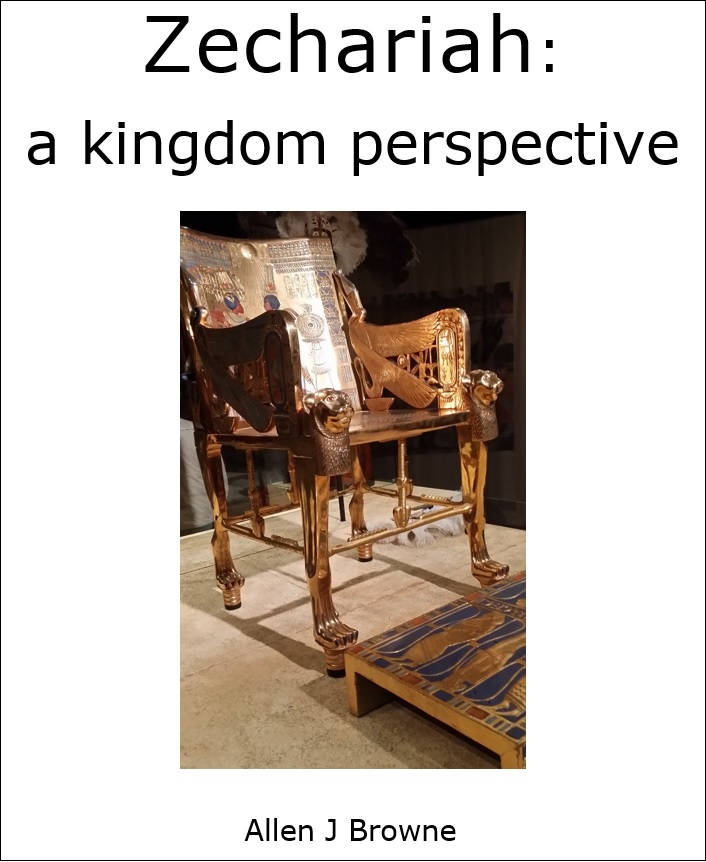
Zechariah: a kingdom perspective (free commentary)

Free commentary containing the 2021 blog posts on the Book of Zechariah.

Here is a free commentary on Zechariah for you to download (PDF, 1MB). It contains all our 2021 posts on Zechariah, including the introduction (below). Enjoy.

Continue reading “Zechariah: a kingdom perspective (free commentary)”

Zechariah’s vision of God’s reign (Zechariah 14:4-21)

The Lord will be king over the whole earth (Zechariah 14:9)

A restructure is common when a new leader takes office. Zechariah’s final chapter envisions a restructure of creation as it comes under divine sovereignty. The heart of the chapter is this: The Lord will be king over the whole earth (14:9). And changing the king changes the kingdom.

In an alien world, Star Trek’s Spock would say, “It’s life, Jim, but not as we know it.” Zechariah is not seeing an alien planet; he’s seeing the removal of everything alien to God’s intentions for life on earth, the terraforming of our planet.

With impressionistic brushstrokes, Zechariah paints an image of God’s reign transforming everything:

Continue reading “Zechariah’s vision of God’s reign (Zechariah 14:4-21)”

Divine sovereignty and human suffering (Zechariah 14:1-5)

Puzzled over how to understand God’s sovereignty? It’s the hope of a suffering world.

Zechariah’s final chapter extends astounding hope in a puzzling framework.

Continue reading “Divine sovereignty and human suffering (Zechariah 14:1-5)”