Your kingdom identifies you (Exodus 2:15-25)

Open Exodus 2:15-25.

Who is Moses? A Hebrew by birth? An Egyptian by nationality? He tried to take a stand with the Hebrews against the injustice of Egypt, but it didn’t work. Now he’s a nobody. Far from the Hebrews and Egyptians. In no man’s land.

Even in the wilderness, injustice reigns. Seven Midianite sisters try to water their father’s flock, only to have male shepherds push in. It’s just like God said: women face gender conflict in a world where rebellion rules (see on Genesis 3:16).

Moses stands up for them, so they return home early with their sheep. Their father’s surprise indicates that this sexist injustice was their daily experience (2:18). Is it only Moses who cares about gender inequality? Or does every form of injustice need to be set right for the kingdom of God to operate as our heavenly ruler intends?

Continue reading “Your kingdom identifies you (Exodus 2:15-25)”
Fighting violence with violence (Exodus 2:11-14)

Open Exodus 2:11-14.

Moses grows up in Pharaoh’s house. He sees how human government operates. The Hebrew slaves weighed down with burdens (2:11, the same word as 1:11).

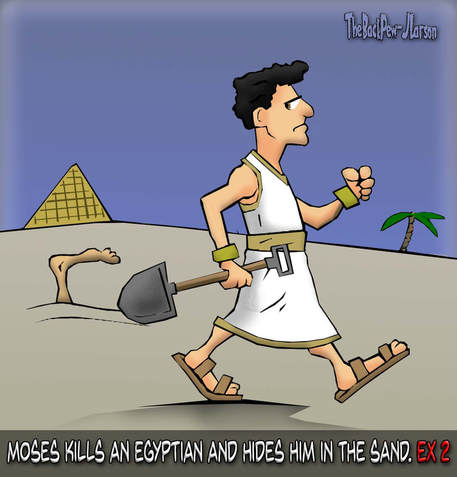
He identifies with them: the Hebrews are his brothers. Moses feels a responsibility to act against the injustice. He sees an Egyptian striking a Hebrew, so Moses strikes the Egyptian. The same Hebrew word (nā·ḵāh) is used to describe both actions. Moses has fallen into the trap of trying to resolve violence through violence. We have already seen how destructive this approach is (compare Genesis 4:23; 6:11).

This temptation will dog God’s people throughout their history. It still does. By responding to oppression with oppression, Moses has become the agent of death rather than the agent of YHWH. He is using his power the way Pharaoh uses it. Killing is not the path to saving. Moses knows his actions are wrong: furtively checking that no one is watching, and hiding the body in the sand (2:12). Continue reading “Fighting violence with violence (Exodus 2:11-14)”

Strong women of Exodus (Exodus 2:1-10)

Open Exodus 2:1-10.

In the opening chapters of Exodus, it’s the women who are the heroes:

  • Shiphrah and Puah (midwives) feared God rather than Pharaoh, disobeying the king of Egypt (1:17).
  • Jochebed (Moses’ mother) dared to disobey Pharaoh by floating her baby in a basket on the Nile (2:1-3).
  • Miriam (Moses’ sister) watched over the baby to guard his life. She approached the princess, and negotiated for their mother to raise Moses (2:7-8).
  • Pharaoh’s daughter changed the course of history by defying her father and rescuing a helpless Hebrew baby from his water-borne basket.
  • Zipporah (Moses’ wife) later recognized his life was under threat, and took action to save him (4:24-26).

Continue reading “Strong women of Exodus (Exodus 2:1-10)”

What do you fear? (Exodus 1:12-22)

What you fear, you serve.

Open Exodus 1:12-22.

Exodus 1 provides real insight into what’s wrong with the powers in the world. To keep people under their control, rulers afflict them with heavy burdens (1:11 ESV). But you can’t squash people so easily: the heavy burdens Pharaoh placed on the Hebrews only made them stronger (1:12). And that’s why rulers become progressively more brutal (pě·rěḵ in 1:13, 14). Continue reading “What do you fear? (Exodus 1:12-22)”

How human rule goes bad (Exodus 1:1-11)

Open Exodus 1:1-11.

By the end of Genesis, one of Abraham’s descendants was bringing divine wisdom to the greatest ruler of his day. In Joseph, Pharaoh saw the spirit of the heavenly sovereign (Genesis 41:38). He followed Joseph’s advice, and many lives were saved.

So is there hope in human rule? After all, human rulers are God’s servants, to limit violence on the earth.

Unfortunately, our human rulers always end up as self-serving. Four centuries later, Egypt has a new king, one who does not know Joseph (Ex 1:8). That means this Pharaoh does not know YHWH either.

The Exodus is not just about the heavenly ruler releasing his people from Pharaoh: it is about the heavenly ruler revealing himself to Pharaoh. The goal is that Pharaoh will know YHWH as earth’s true ruler (5:2; 6:7; 7:5, 17; 8:10 and so on). Exodus 1–15 is a confrontation between rulers, a kind of war—a challenge over who rules. It is a kingdom conflict—the paradigmatic kingdom confrontation of the Old Testament. Continue reading “How human rule goes bad (Exodus 1:1-11)”

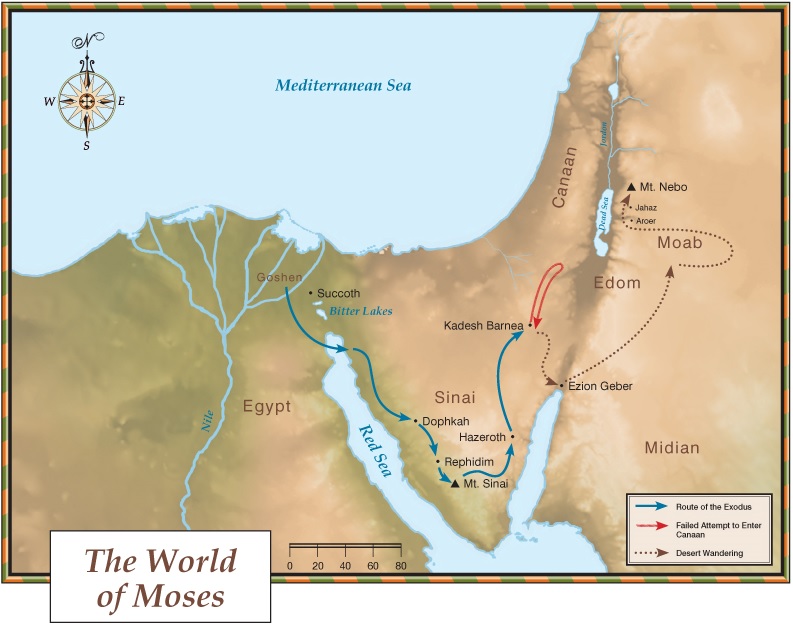
Exodus: the setting

What do we know from history about the exodus?

Please don’t believe everything you find in the Internet about the exodus. There are some outlandish claims. Some claim to have found the ark of the covenant, Noah’s ark, and everything in between. Some claim to have evidence of the exodus in the wrong time period. The truth is that there is no indisputable archaeological evidence to corroborate the narrative of the exodus.

Continue reading “Exodus: the setting”

Exodus: God’s kingdom established

Exodus is a kingdom of God story. What does it say?

Exodus provides a powerful revelation of who God is. He is the true ruler. Pharaoh cannot rule God’s people. That’s good news.

While Riverview College is launching, I’ll be posting on what Exodus says about our heavenly sovereign, from an Advance in Faith series (unit 220).

Exodus is about God’s kingship — establishing a nation under his rule and law, living among his people. Continue reading “Exodus: God’s kingdom established”

A tale of two kings (Matthew 14:1-21)

How do we present Jesus as king, when he’s so different to the rulers appointed by this world?

Open Matthew 14:1-21.

Jesus’ regal authority can frighten people. We’ve all experienced power being abused. So how do we announce a king who cares for his people?

We’ll need to explain the contrast. Matthew shows us how by juxtaposing the stories of two kings. Continue reading “A tale of two kings (Matthew 14:1-21)”

Feeding the multitude (Matthew 14:13-21)

What are we to learn from unusual miracles like the feeding of the 5000?

Open Matthew 14:13-21.

Feeding the 5000, or walking on water. They’re favourites that capture our imagination, but why did Jesus do these things? If they were signs, what were they pointing to? Was he showing off? Was he telling the crowds he was God? What was Jesus doing? Continue reading “Feeding the multitude (Matthew 14:13-21)”

What power do the rulers of this world have over God’s people? (Matthew 14:1-12)

Are we safe from harm? Or can God’s people be hurt by the evil in the world?

Open Matthew 14:1-12.

As you read the Bible, do you notice how the stories fit together? Why would Matthew stop talking about Jesus and tell a story about Herod instead? What’s his point?

Continue reading “What power do the rulers of this world have over God’s people? (Matthew 14:1-12)”

How does Jesus become king? (Matthew 13:53-58)

How does Jesus receive the kingship if people don’t give it to him?

Open Matthew 13:53-58.

Jesus taught like an artist. His word pictures lift us above the human conflicts to a plateau where we can see what the earth was meant to be — a place of peace, responsive to heaven’s government.

This is future, yet it’s already here in the present. Jesus has re-sowed God’s world, and some seeds are heading toward harvest. Sure, there are weeds in God’s field, but there’s wheat as well. The mustard seed is growing. The leaven is permeating the dough. People trade other dreams for God’s reign. The net is in the water, and God will sort the good from the bad.

God’s reign is here. Only the good that God intended will last.

Jesus’ kingdom vision was inspiring, but was it credible? Compared to Herod or Caesar, what kind of king was Jesus of Nazareth?

Continue reading “How does Jesus become king? (Matthew 13:53-58)”

Trained for kingdom business (Matthew 13:51-52)

Can Jesus teach us to present his kingdom in our setting?

Open Matthew 13:51-52.

The final parable of Matthew 13 would be the most relevant and practical of all, if we understood it. It’s the final application, the “so what” of the kingdom parables. Jesus commissions us to do something with the kingdom.

But what is he asking us to do by telling a story about a householder laying out his new and old treasures? Continue reading “Trained for kingdom business (Matthew 13:51-52)”

Why doesn’t God sort it out? (Matthew 13:47-50)

If God is all-powerful and all-loving, why doesn’t he sort out injustice now?

Open Matthew 13:47-50.

Why is the world such a mess if it’s God’s kingdom? How can so much evil and injustice exist in the kingdom of God?

Why doesn’t our heavenly king sort out his earthly realm? Is this really the best God can do?

That’s no theoretical question. Ask the people in pain. Ask the parents of the 17 killed at Marjory Stoneman Douglas High School in Parkland, Florida in February. Why doesn’t God act? Philip Yancey calls it, “the question that never goes away.”

Megaphones blare, “What do we want? Justice! When do we want it? Now!Continue reading “Why doesn’t God sort it out? (Matthew 13:47-50)”

What’s the value of God’s reign? (Matthew 13:45-46)

What would it be worth to have God reigning over us?

Open Matthew 13:45-46.

Did you hear the one about the art lover who found an original by someone she and her husband admired? She texted the details to get his opinion. Between meetings, he rushed back a reply, “No. Price too high.” But his fumbling fingers missed the full stop. The text she received read, “No price too high.”

Did you hear the one Jesus told about the pearl merchant? He found the one he’d been waiting for, the elusive pearl with flawless shape, glistening tone, and perfect lustre. He traded everything away to have the thing he’d been waiting his whole life to find.

For Jesus, God’s reign over the world is that one thing worth trading everything for. Like the pearl merchant you might recognize it as the thing you’ve been searching for. Or you may not have been searching; perhaps you just stumbled on it, like treasure buried in a field. Either way, when you see it for what it is — the possibility of everything on earth functioning as beautifully as it was designed to do — what value do you place on it? Continue reading “What’s the value of God’s reign? (Matthew 13:45-46)”

Discovering what counts (Matthew 13:44)

What’s your dream? And what will you do to get there?

Open Matthew 13:44.

What’s your dream? And what would you do to get it? Your honest answers to those questions reveal more about you than you realize.

Someone caught up in the first euphoria of love dreams of a beautiful life with that special someone, whatever it costs. The entrepreneur dreams of owning the Monopoly board, driven by a plan that just might give it to him.

But our best dreams are bigger than ourselves. Dreams like clean drinking water for Africa, empowering locals to transform Cambodia, or A21’s audacious vision to end modern slavery. Syrians dream of living in a country where they need not fear being shot, and some young Americans do too. Martin Luther King Jr still speaks, “I have a dream …”

The trouble with dreams is that the how is more difficult than the what. Continue reading “Discovering what counts (Matthew 13:44)”

What’s the Bible’s main theme?

What is the Bible about? What picture do you get when you put the pieces together?

Say your niece is reading The Chronicles of Narnia. You ask, “What do you think the story is about?” and she says, “I think it’s about the wardrobe.”

“What about the lion? Was the story about him?”

“Well he’s in the story, but the wardrobe is important. Don’t you see? That’s how you get in. That’s why it’s the final word in the title.”

You might wonder how much of the story she’s read. But how do you go about identifying the core theme of an extended story like Narnia, Lord of the Rings, or the Bible.

What is the Bible’s message? Is personal salvation the main theme? Or is that just the bit about how you get in? Continue reading “What’s the Bible’s main theme?”

Parables help us get our bearings (Matthew 13:34-35)

Wisdom: learning from where we’ve been, to end up in a better place.

So why did Jesus speak in parables? He was revealing divine plans that had been confidential since the world was founded.

That’s how Matthew’s community understood him, based on Psalm 78:2:
I will open my mouth in parables; I will utter what has been hidden since the foundation of the world (quoted in Matthew 13:35).

But why did they think that Psalm was about Jesus? Was it just because the Psalm used the word parable? Continue reading “Parables help us get our bearings (Matthew 13:34-35)”

Infecting the world with good (Matthew 13:33)

How is the kingdom of heaven like a woman baking bread?

There’s nothing like the smell of fresh bread in the morning. Flour, water, and yeast go in the bread maker in the evening, and in the morning the aroma of fresh bread helps you rise to a new day.

We have it so easy. Back in Jesus’ day they kneaded the dough by hand, kept aside some sourdough as leaven for tomorrow, waited for it to rise, punched it down again, waited some more, and then built a fire to bake it.

Jesus told a story about a woman who must have been baking for a party. She took her leaven and hid it in three big 8 kilogram batches of flour. How on earth is the heaven’s kingdom like that? Continue reading “Infecting the world with good (Matthew 13:33)”

The little seed that filled the world (Matthew 13:31-32)

A few years back, our film crew sent this email from Israel:

Dear Allen. We’re trying to film a mustard tree, but our guide says mustard seeds only grow to be shrubs. We got some great shots of the mustard seeds, but now we’re stuck. Any ideas?

They were talking about these words from Jesus: Continue reading “The little seed that filled the world (Matthew 13:31-32)”

What about the weeds in God’s world? (Matthew 13:24-43)

How can God allow good and evil to coexist and not sort it out?

Open Matthew 13:24-43.

Jesus told some funny stories. The farmhands find weeds in the wheat field, so they ask if they should pull out the weeds. The farmer says, “I sowed good seed, so our enemy must have come and planted the weeds while we were all asleep.” Never in my life have I met a farmer who would jump to that conclusion!

Even funnier is the farmer’s response, “Nah! Leave all the plants growing in the field. We’ll sort them out at harvest time. If I let you lot pull out the weeds, you’ll pull out some of my wheat as well.”

There is no way Jesus could get a position at agricultural college if he gives that advice to his students. Why would he dream up such a story?

Continue reading “What about the weeds in God’s world? (Matthew 13:24-43)”