

This podcast covers the topics blogged from Genesis 3:
Category: Allegiance
The question of trust (Genesis 3:1-7)

If your Bible adds headings over the text, it probably labels Genesis 3 as “The Fall.” Theologians use that term to describe humans “falling” from their perfect state, becoming sinners subject to death. Christian theology of the fall is based on Paul’s letters (Romans 5:12-19; 1 Corinthians 15:21-46).
In reading Genesis 3, Christians often substitute “Satan” for serpent. We reason that it must have been the devil, because snakes can’t talk. We think humans fell because the devil tempted them. And in the Bible’s final book, that ancient serpent is identified with the devil or Satan (Revelation 12:9; 20:2).
But that approach misses the way the story is told in Genesis where it’s about the chain of command. Say you’re reading a spy novel and there’s a kidnapping in the first chapter. Later in the book you learn the kidnapper was working for a foreign power, aiming to destabilize the government, but you didn’t know that in the opening chapter. Let’s try reading Genesis 3 in its immediate context.
When the last man falls (Matthew 26:69-75)
Seeing no alternative, Peter disowned his king. Jesus never gave up on him.
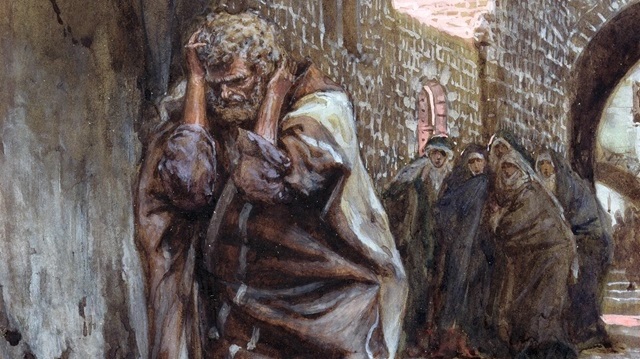
Why did Peter deny Jesus? Was he just sitting at the wrong fire, in a crowd where he didn’t have the gumption to admit he was Jesus’ follower? That isn’t how this story works in Matthew’s Gospel.
Peter was the first to acknowledge Jesus as the Christ, God’s anointed leader (16:16). Jesus blessed him, but realized Peter had no idea of the conflict ahead. Peter’s denial began when he said, No Lord! This will never happen to you! Denying that Jesus would die at the hands of the Jerusalem leaders placed Peter on the enemy’s side (16:21-23). Peter could understand taking up his sword and kill to save his king (26:51-52), but he could not understand taking up his cross to follow the king into death to save his realm (16:24-28).
Once Jesus removed fight from the agenda, flight was the only option his followers could see. That’s why, All the disciples deserted him and fled (26:56).
Peter could make no sense of what was happening, but he couldn’t stay away either. Peter followed him from a distance … to see how it would end (26:58). That’s the reason Peter was there, trying to blend in with Jesus’ antagonists. That was never going to work, of course. A lumbering fisherman sprouting Galilean phrases was as inconspicuous as an Aston Martin in a spy movie.
Continue reading “When the last man falls (Matthew 26:69-75)”
Where’s your allegiance? (Matthew 10:32-33)
What country do you belong to? It depends on who’s your leader.

Open Matthew 10:32-33.
If John Clarke was still with us, he’d be having a field day. How do you bring down a democratic government? Demonstrate that many sitting members weren’t eligible to stand.
Now, politics is a serious business. Our leaders must have unquestionable allegiance to our nation. If war broke out, which side would a dual citizen support?
I mean, you couldn’t trust Barnaby Joyce as deputy prime minister if he’s secretly a Kiwi. If New Zealand invaded us, the haka alone would probably see him siding with the enemy. Well, that’s what the high court ruled anyway: they declared him unfit to be a sitting member, so he has to stand again. Continue reading “Where’s your allegiance? (Matthew 10:32-33)”
 Seeking the kingdom