
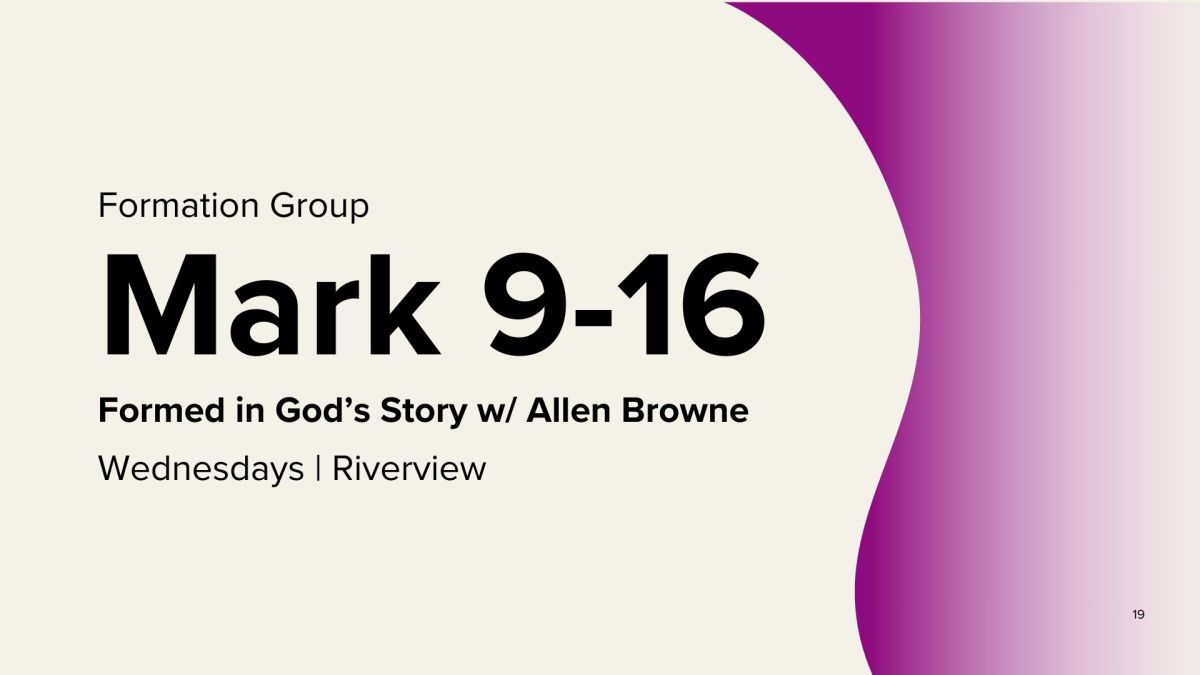
Update 2026-09-18: Added final podcasts and full notes.
With the Messiah’s identity revealed in Mark 8:29, the second half of Mark’s Gospel is all about the Messiah’s mission to save a world that wants to be rid of him. How does he make atonement between heaven and earth … with a cross?
Over six Wednesday evenings in August/September 2026, we’ll heard and saw Jesus’ answers to those questions, as he taught us about the cross and shouldered it to redeem the world.
You can now download the full notes as a single PDF, or the weekly notes and podccasts below:
- Week 1 (12 Aug 2026). The mission of the Messiah (Mark 9). Notes.
Podcast 1a: “This is my Son. Listen to him!”
Podcast 1b: What Jesus says about Gehenna. - Week 2 (19 Aug). The journey to Jerusalem (Mark 10). Notes.
Podcast 2a: Divorce and Jesus’ values.
Podcast 2b: Jesus’ explanation of the cross. - Week 3 (26 Aug). The authority of the king (Mark 11–12). Notes.
Podcast 3a: Recognizing Jesus’ authority
Podcast 3b: Not recognizing Jesus’ authority - Week 4 (2 Sep). The city that rejects its king (Mark 12–13). Notes.
Podcast 4a: The king and his enemies (Mk 12:28–13:13)
Podcast 4b: The fall of Jerusalem (Mk 13:14-37) - Week 5 (9 Sep). Preparing for the death of the king (Mark 14). Notes.
Podcast 5a: Anointing, Passsover, and new covenant (Mk 14:1-26)
Poccast 5b: Arrested, condemned, and abondoned (Mk 14:27-72) - Week 6 (16 Sep). The Messiah: killed and raised (Mark 15–16). Notes.
Podcast 6a: The crucifixion of the Christ (Mk 15)
Podcast 6b: The good news of his resurrection (Mk 16)
Our next course will be Job and the Justice of God, 21 October to 25 November 2026, at Riverview Church in Perth, Western Australia. Registrations open. Details to follow in another post.
Sample
Last term we looked at Mark 1–8 where the key question was, “Who is this?” Eventually Peter provided the answer: “You are the Christ!” (8:29)
Mark 9–16 then deals with the mission of this Messiah. The Christ is the anointed ruler sent by heaven to rescue the earth. The Christ restores us as a society under heaven’s reign, what Jesus called the kingdom of God (Mark 1:15; 4:11, 26, 30; etc).
Jesus explains that the path to power for this Messiah involves a cross. As soon as they recognized his authority, he began to teach them that the Son of Man must suffer many things and be rejected by the elders, the chief priests, and the teachers of the law, and that he must be killed and after three days rise again (Mark 8:31).
How does the cross save us? That’s the main theme of Mark 9–16.
The last 2000 years have seen many explanations of how the cross saves us. They’re called atonement theories. Most of these theologies of atonement are drawn from the epistles, with just one case in the Gospels where Jesus used the word ransom (Mark 10:45 || Matthew 20:28). In other words, most atonement theories are not based on the extensive teaching Jesus gave about the cross.
Listening to Jesus reshapes how we understand the cross. Some Christians think, “Jesus suffered for us, so we don’t have to.” The first thing Jesus says about the cross overturns that view: “Whoever wants to be my disciple must deny themselves and take up their cross and follow me” (8:34, compare Matthew 10:38; 16:24; Luke 9:23).
Whatever Jesus was doing with the cross to save the world, he wants us to do it too. The kingdom follows what the king does. We participate in Messiah’s mission by absorbing the evil done against us, just as he did. We follow him in bearing away the sin of the world in our bodies too, for the renewal of creation.
The cross is not a theory about how God sets individuals right with himself; it’s the foundation for the society that comes to life in Christ. By following him we share in the death and life of the Messiah whom God raised up to lead his kingdom.
That is what the cross achieves as we follow him. Are you ready to explore the Messiah’s mission as he describes it in Mark 9–16?
Related posts
The Formed in God’s Story series has previously provided notes and podcasts on:
- Mark 1–8 (six sessions)
- Matthew 1–14 and 15–28 (twelve sessions)
- Acts (seven sessions)
- Romans 1–8 and 9–16 (twelve sessions)
- Revelation (six sessions)
- Exploring the Bible (six sessions)
- Genesis 1–12 (six sessions)
- Genesis – Esther (six sessions)
- Psalms (six sessions)
- Isaiah (six sessions)
- Old Testament Prophets (six sessions)


