
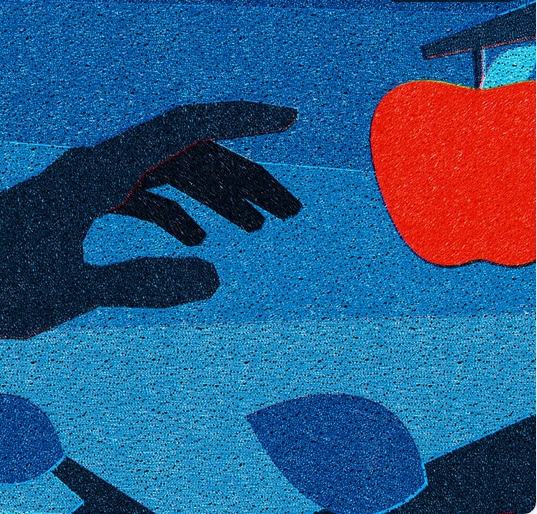
If your Bible adds headings over the text, it probably labels Genesis 3 as “The Fall.” Theologians use that term to describe humans “falling” from their perfect state, becoming sinners subject to death. Christian theology of the fall is based on Paul’s letters (Romans 5:12-19; 1 Corinthians 15:21-46).
In reading Genesis 3, Christians often substitute “Satan” for serpent. We reason that it must have been the devil, because snakes can’t talk. We think humans fell because the devil tempted them. And in the Bible’s final book, that ancient serpent is identified with the devil or Satan (Revelation 12:9; 20:2).
But that approach misses the way the story is told in Genesis where it’s about the chain of command. Say you’re reading a spy novel and there’s a kidnapping in the first chapter. Later in the book you learn the kidnapper was working for a foreign power, aiming to destabilize the government, but you didn’t know that in the opening chapter. Let’s try reading Genesis 3 in its immediate context.
God had honoured Adam and Eve by crowning them as king and queen of creation. They represented the heavenly sovereign’s majesty to all the creatures of the earth. Psalm 8 is a beautiful Jewish commentary on Genesis 1-2:
Psalm 8:5-9 (NIV)
5 You [Lord] … crowned them with glory and honour. 6 You made them rulers over the works of your hands; you put everything under their feet: 7 all flocks and herds, and the animals of the wild, 8 the birds in the sky, and the fish in the sea, all that swim the paths of the seas. 9 Lord, our Lord, how majestic is your name in all the earth!
In the context of Genesis, the snake is one of the creatures they’d been told to rule over, to subdue (1:28). The snake approaches Queen Eve as if it’s treating her as the appropriate authority in God’s earthly realm. But we’re warned that this creature is not being up-front about what it wants:
Genesis 3:1-5 (NIV)
1 Now the serpent was more crafty than any of the wild animals the Lord God had made. He said to the woman, “Did God really say, ‘You must not eat from any tree in the garden’?”
2 The woman said to the serpent, “We may eat fruit from the trees in the garden, 3 but God did say, ‘You must not eat fruit from the tree that is in the middle of the garden, and you must not touch it, or you will die.’ ”
4 “You will not certainly die,” the serpent said to the woman. 5 “For God knows that when you eat from it your eyes will be opened, and you will be like God [or gods], knowing good and evil.”
The crafty creature plants the seed of an idea that Queen Eve could act independently of what God decreed (verse 1). The creature assures Eve she would be more powerful if she bypassed God. It pretends to be seeking their honour: they could be a like gods (ělō·hîm) if they decide good and evil for themselves (verse 5).
What is the crafty creature really after? Autonomy. If the Queen breaks the line of authority the humans have received from God, then the authority God gave humans over the animals is also broken. The creational order God established will fall.
Every king and queen of the ancient world has faced this kind of request. Citizens present a request as if it will benefit the monarch, when it actually undermines the monarch’s authority. Politicians and parents know this strategy too.
In verse 6, we find that King Adam is present as well. In Hebrew, the pronouns give this away: the creature has been addressing Queen Eve, but it’s been using masculine plural pronouns—including King Adam as well.
Queen Eve and King Adam don’t yet have the wisdom to recognize the ruse. They now see the tree as a way to know good and evil for themselves, to be gods in their own right instead of relying on God for the knowledge of good and evil. They take the bait:
Genesis 3:6-7 (NIV)
6 When the woman saw that the fruit of the tree was good for food and pleasing to the eye, and also desirable for gaining wisdom, she took some and ate it. She also gave some to her husband, who was with her, and he ate it. 7 Then the eyes of both of them were opened, and they realized they were naked; so they sewed fig leaves together and made coverings for themselves.
They experience evil. They feel the shame. Their relationship with God, with each other, and with the creatures will never be the same (verse 7).
So what?
It’s a cosmic trainwreck, derailing the lines of authority God established. The impact is earth-shattering. They’ve undermined the peaceful order God established. Earth is now a warzone. People and creatures fight each other because we’ve rejected God’s authority to define good and evil, redefining “good” to mean “what’s good for me.”
Next time we’ll see how God responds.
Related posts
- Who’s in charge now? (Gen 3:1-14)
- Original good (Genesis 1–4)
- God’s authority in heaven and on earth (Gen 1:14-31)

 Seeking the kingdom
Any interesting question might be, why a snake? After-all, humans were to rule over and subdue all of creation. If we remember the historical context of the original audience to whom Genesis was given, the Hebrews coming from an Egyptian culture, then maybe the answer is this. Apep, was the ancient Egyptian deity who embodied darkness and disorder and was thus the opponent of light and, in the Egyptian creation myth, Ma’at (order/truth). He appears in art as a giant serpent. This is what the Hebrews knew so the appearance of a snake looking to undermine the order that Yahweh was bringing to creation, is not surprising.
LikeLiked by 1 person
Interesting, Graham. I love that you’re looking in the ancient world, to see what other images from their world could have influenced what the story meant to them. But I’m not sure that connecting this story to an Egyptian god is the right link to make.
The snake is identified as one of the “wild animals” (3:1), a phrase well-defined in this story (1:24, 25, 28, 10, 19, 20), specifically as a class of creature over which the humans must rule. I don’t see anything in the story that suggests connecting this animal-of-the-field (ḥǎyyǎṯ hǎśśāḏěh) to an Egyptian god.
LikeLike
Yes, true. I’m not suggesting that the image is that of the Egyptian god but maybe the snake brought to mind the ideas of chaos and anti-creation for the Hebrews.
LikeLiked by 1 person